
The visual choices brands make in their patient marketing materials can play a bigger role than simply conveying a consistent and familiar brand identity. Instead, visuals in patient marketing materials are key for supporting patients’ understanding of, and engagement with, their treatment options. This is especially true for advanced therapies, where a thoughtful visual strategy can help patients make difficult decisions for complex treatments.
Helping patients see themselves in images
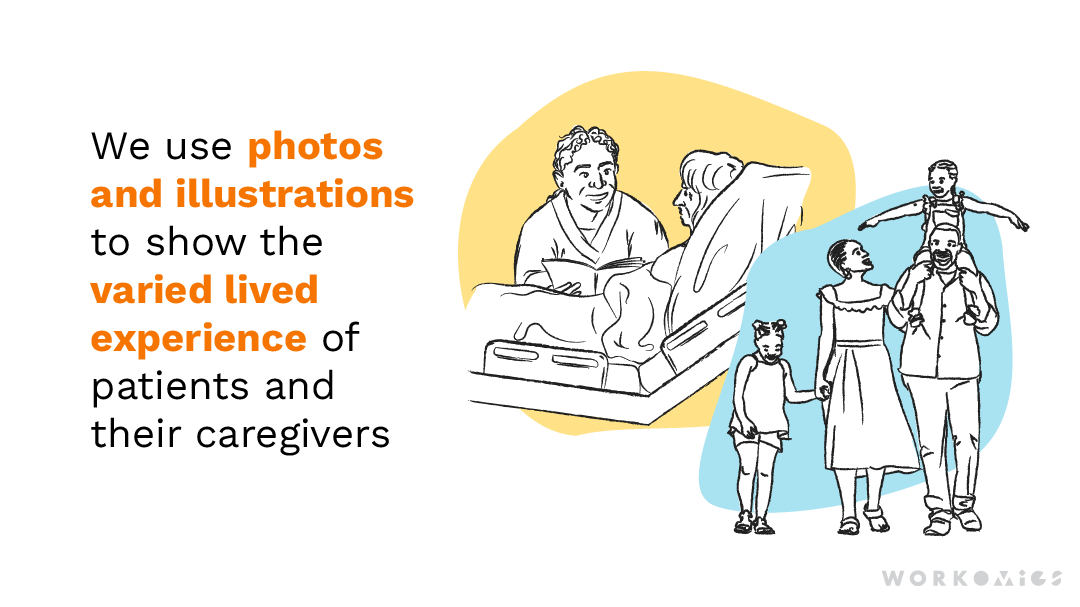
A frequent approach to patient marketing is to use actors, or more recently AI-generated images, which can lead to a disconnect between the information provided and the true patient experience. When creating visuals in brand marketing materials, we strive to combine photos and videos of real patients alongside illustrated scenarios, showing diverse experiences and building trust as a result.
By prioritizing real patients and caregivers in videos and photographs, we are able to better reflect the reality of patients’ lived experience, without overpromising unrealistic expectations or implying treatment efficacy. When possible, videos allow us to depict more nuance and range of emotions, as patient ambassadors talk about their own experience with the treatment process, disease state, caregiving, and other relevant topics.
We also rely heavily on illustrations to depict scenarios and actions that are difficult to capture authentically in photos, such as taking care of one’s mental health, chatting with an HCP or caregiver, or the various steps of complex treatments. Illustrations allow us to represent diversity in the patient population, make concepts and ideas relatable, and set appropriate expectations with patients and caregivers through the details we depict. Lastly, illustrations are particularly helpful in fine-tuning facial expressions and details to stay within regulatory guidelines.
Simplifying complex concepts
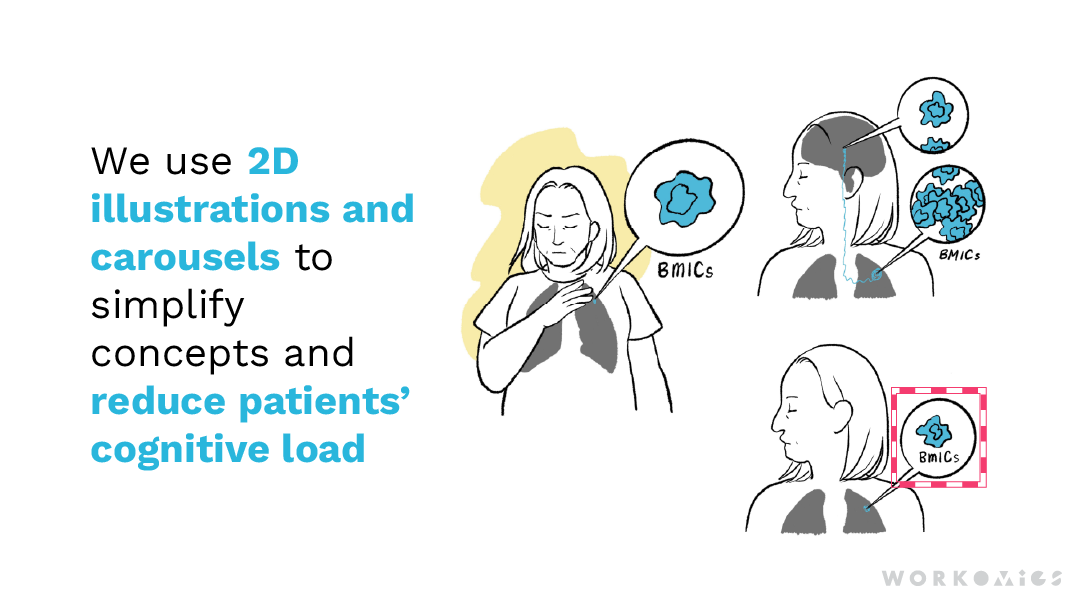
The visuals that brands employ in their marketing materials are one of their most powerful tools for simplifying complex medical and scientific concepts, such as how a therapy works in a patient’s body. Keeping medical and scientific illustrations simple and focused can help build patient understanding without adding too much to the cognitive load of someone already managing an advanced or complex disease.
For patient marketing materials we use 2D illustration styles with restrained colour pallets, fine details only where needed, and depict a limited number of well-labelled subjects or actions. When compared to the detailed 3D renderings common in HCP and some patient marketing materials, this method feels more approachable to patients, and is more effective at drawing their attention to key points instead of peripheral details.
Some medical processes and procedures are necessarily complex and multi-step. Instead of creating more complex illustrations in these scenarios, we rely on sequential visuals that break things down into discrete and easily understandable steps. For example, these illustrations can live as interactive carousels on a website that patients can scroll through at their own pace. A 2D illustration approach also translates well to animation, where complex processes can be brought to life for a patient audience more cost effectively than 3D animation or live action video.
Making things easier for patients
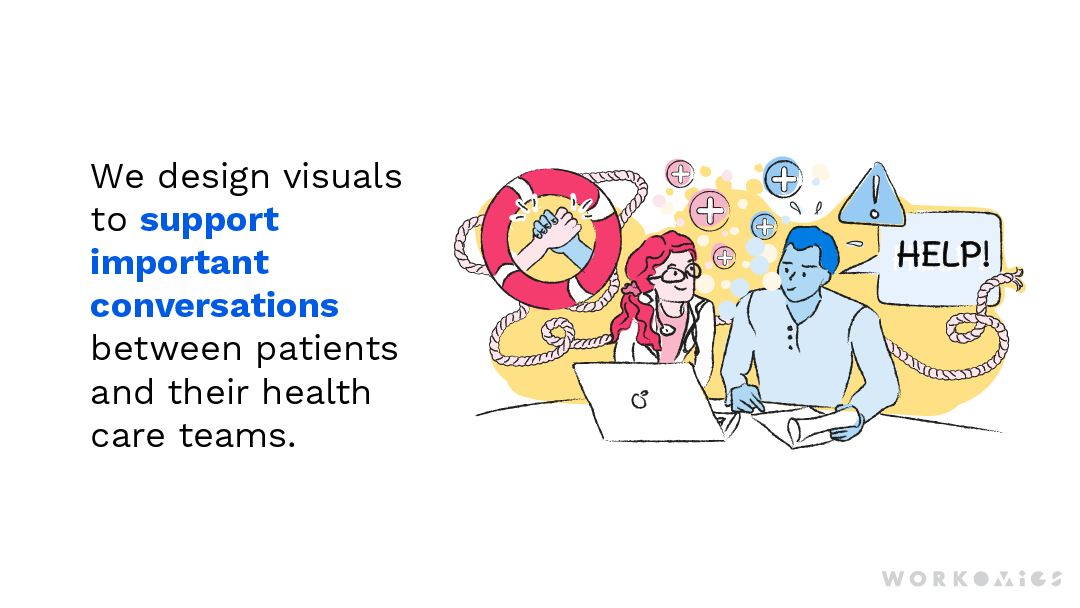
Patients in the midst of making a treatment decision are bombarded with medical information and logistics. This is especially true for patients managing advanced and complex diseases, where time pressures are greater, and treatments are more difficult to understand. It’s not enough in this context to make patient marketing materials that are simply memorable; they need to be practical tools that patients can use along their treatment journey and in important conversations with their health care team.
Visual strategy can be used to reinforce this important goal of patient materials. For example, one brand may offer a glossy full-colour brochure, while another may provide patients with simple illustrations and lots of white space. The latter would be much easier for doctors, nurses, or patients to record notes or sketches, making it an important resource for patients to reference over time. Using action icons—such as conversation bubbles, phones, and caution signs—can also draw patient attention to key things to discuss with their doctor.
A thoughtful visual strategy should include honest depictions of patients in photos and videos, emotionally sensitive illustrations that capture the salient details, and simple visual diagrams that clarify complex processes. When repeated across a patient brand marketing campaign, this approach to visuals helps build a cohesive brand narrative that is memorable for the clarity and practical support it provides to patients.
Our other ideas worth exploring

Thinking holistically about the patient experience
Patients with rare and complex diseases need brand marketing materials that offer concrete support. That’s why our approach is built on clear and effective communication, holistically integrating UX, visuals, clinical trial data, and important safety information.

Human-centered systems thinking: lessons from the Sepsis Watch rollout
Back to Ideas Some time ago, we came across an insightful article in the MIT Technology Review discussing the rollout of Sepsis Watch, a...
Form design 101
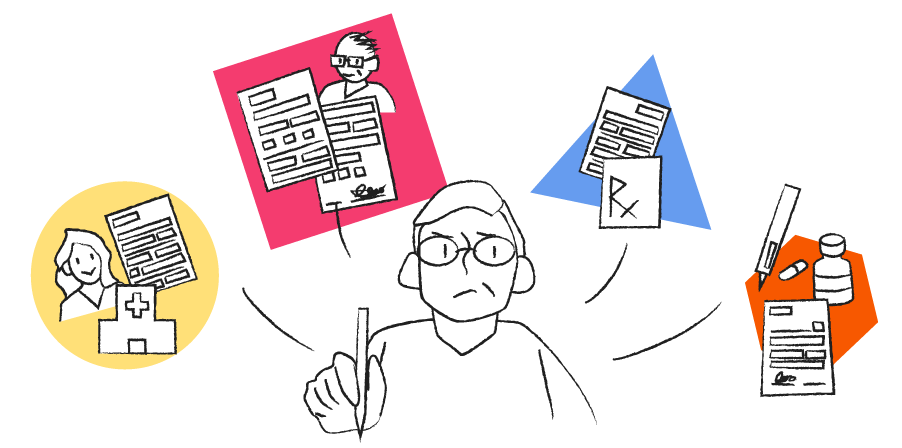
The experience of using and designing a form – an integral step to providing care that shapes the overall patient experience