
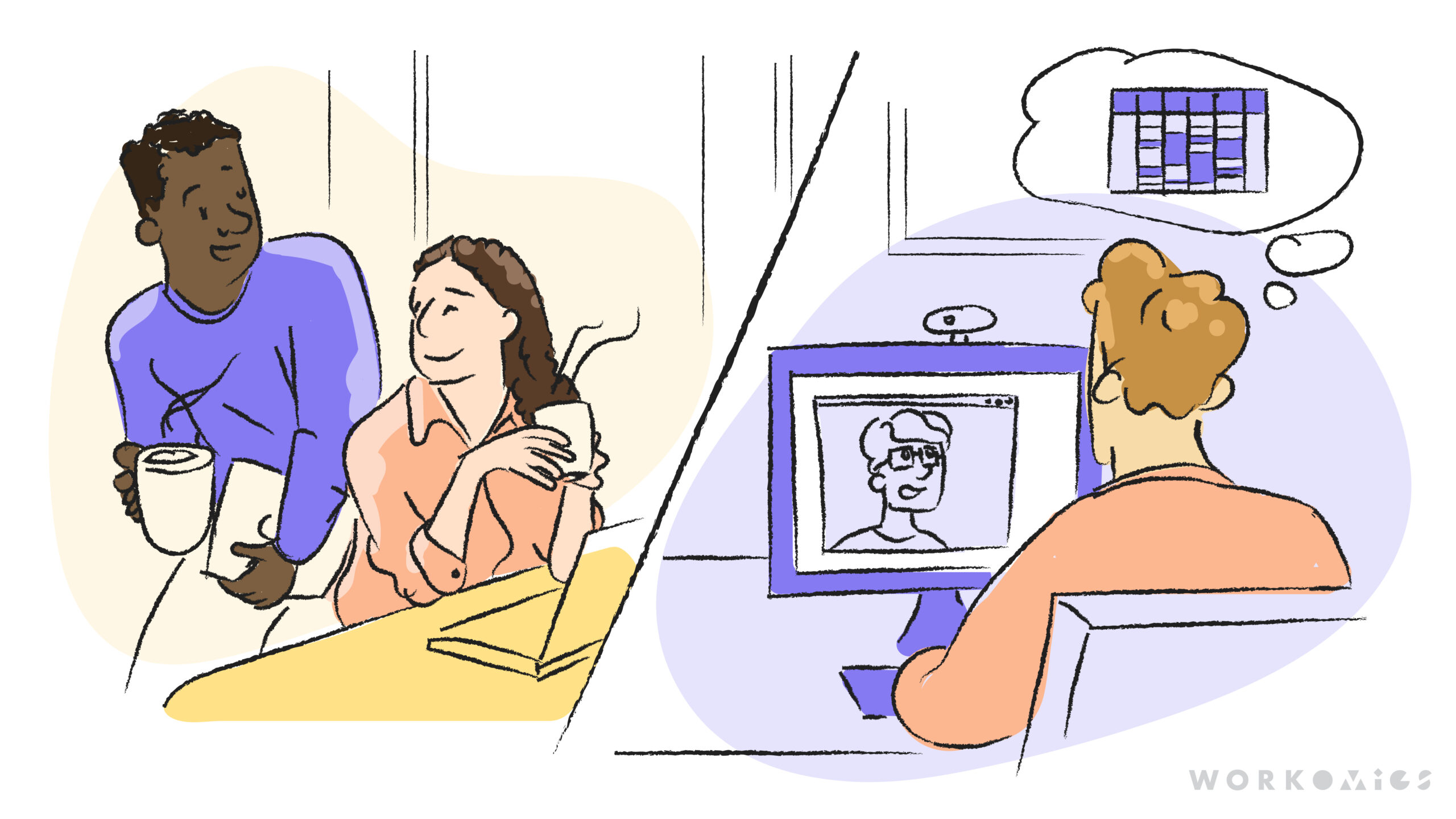
One problem is that relationship work is important, but not urgent. Like all work of that kind, it is so very prone to being pushed to one side when things get busy. And when you’ve got a pile of impending deadlines, of course you’re going to reschedule that discretionary coffee meeting. But the nature of modern knowledge work is that there is always a pile of impending deadlines, and the coffee meetings aren’t so discretionary. If you’re not careful, you’ll look up and four months have passed without your having connected with any colleagues outside the day-to-day grind. That’s especially true when you’re working remotely, because the scheduled meetings are often the only time you have an actual conversation with your colleagues.
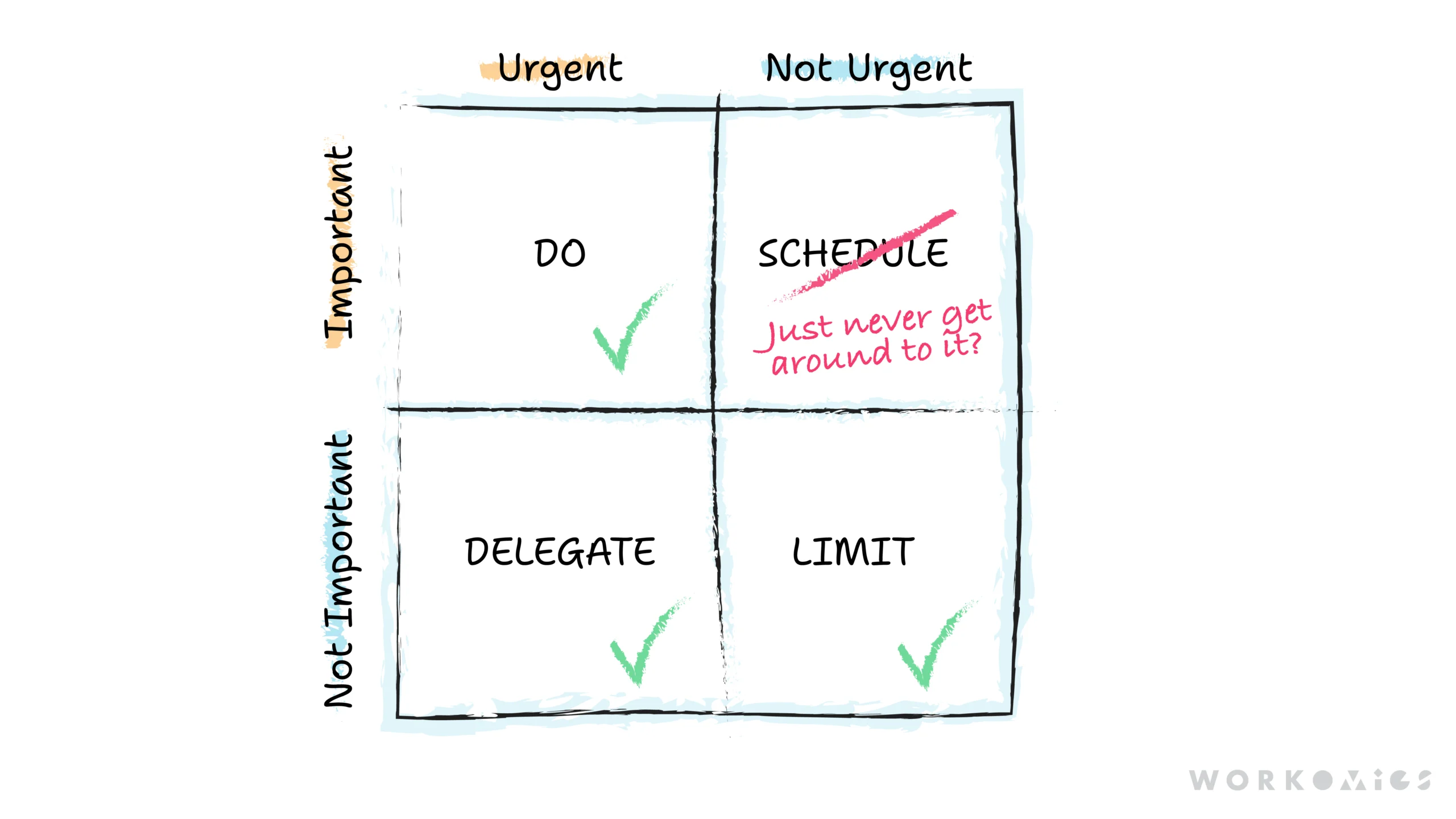
Coffee meetings, often.
Another challenge is having the right kinds of conversations. To build trust and deepen relationships, you need to reveal things about yourself. In her book Remote Work Revolution, Tsedal Neeley talks about what kinds of self disclosures actually build the most trust. She highlights the need for interactions to have depth, breadth, duration, and reciprocity in what people say about themselves. Sharing your opinions and values builds more trust than merely describing events. Basically, you can’t just have small talk — building trusting relationships requires deep and meaningful conversations.
There’s a very real sense in which organizations have been free-riding on the in-person bonds established prior to March 2020. But whether or not the Great Resignation is a real phenomenon, natural turnover means that many knowledge workers have a bunch of new coworkers they have never met in real life. Do we engage with these new employees on a surface-level, sticking to work-related topics? Or do we connect more deeply by making self-disclosures? Our sense of belonging and connectedness in the workplace might hinge on the answer.
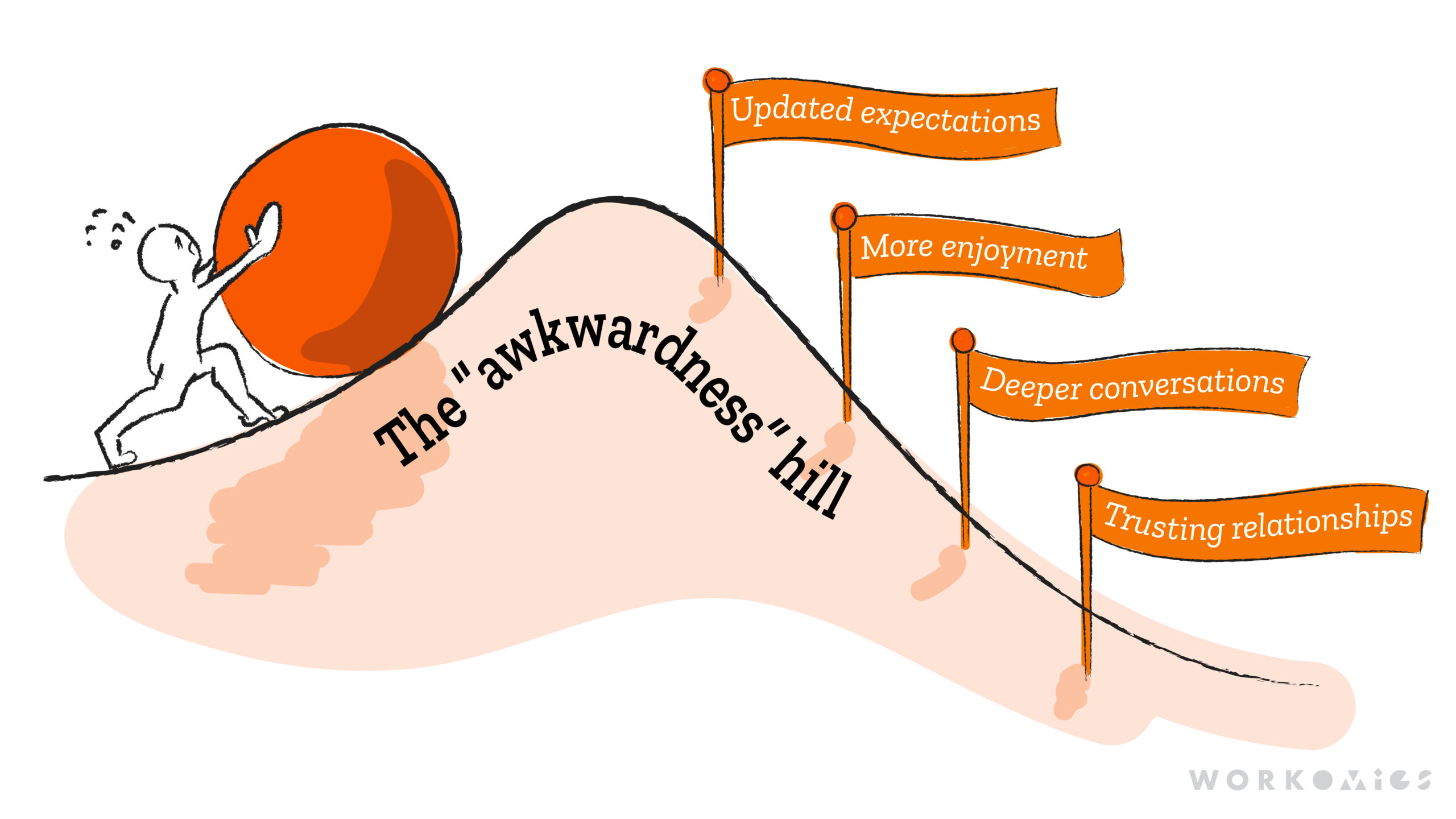
Unfortunately, some new research* shows that our natural instincts in this area are counterproductive. In a series of seven controlled experiments, Michael Kardas, Amit Kumar, and Nicholas Epley found that we both overestimate the awkwardness of deeper conversations, and underestimate the degree of connectedness we will feel from going deeper. Having a deep conversation with another person is a surprisingly positive experience. People report really enjoying them, after the fact. But beforehand, we expect it to be an awkward experience, so we end up avoiding the very thing that could cultivate more meaning and belonging in the workplace.
Fostering a Culture of Pushing Through the Awkward
The solution here, it seems, is to push through the awkwardness and have a deeper conversation than we think will feel comfortable. If we push through the awkward, Kardas et al.’s work suggests there will be a positive reinforcement loop. We’ll update our expectations to more accurately predict how much we enjoy deep conversations and how little awkwardness we actually experience. The more deep conversations we have, the more we want to have.
For organizations, there is a bigger opportunity to actually create cultural expectations around deep talk in coffee chats. The highly-engineered version of this could be facilitating activities based on Arthur Aron’s Fast Friends Protocol, where two people take turns asking and answering questions that gradually delve into deeper waters. By tailoring the questions to explore how individuals relate to organizational values, it can become a way to develop interpersonal relationships while also creating deeper cultural alignment.
But Kardas, Kumar, and Epley’s work suggests you can get to deeper conversations with just by encouraging people to reframe their conversations a bit. As much as we overestimate awkwardness and underestimate rewards of deep talk, people actually have good intuition as to what kinds of questions will facilitate deeper conversation. Kardas, Kumar, and Epley asked research participants to write both ‘standard’ questions to get to know someone new, as well as ‘deep’ questions, and found that the deep questions were meaningfully more intimate than the standard ones†. Kardas, Kumar, and Epley also found that people are more likely to voluntarily choose deep conversations in one of two circumstances:
- They are told their interlocutor is caring and considerate
- That people tend to underestimate how much others will care about our responses to more intimate questions (i.e. given the results of this research.
We think that this suggests some simple framing might help people connect more deeply: “Here at company X, we’re all a caring bunch, and research shows that people find coffee chats more rewarding when they delve deeper — so try to ask each other questions that go beyond the surface and beyond small talk.”‡ Messaging like that in calendar invites or donut bots is a low-cost way to boost the chances for meaningful connection that strengthens social ties throughout an organization. There’s nothing specific to remote work about any of these findings, but I think it’s all the more important when we’re losing the casual, serendipitous encounters of face-to-face work.
Footnotes:
* You can check out the full research paper from the Journal of Personality and Social Psychology, or a nice summary the authors wrote up in The Washington Post
† They assessed this via Mechanical Turk
‡ This is a riff on the wording Kardas, Kumar, and Epley used for their participants in Experiment 3. They also provided examples of deeper questions in their prompt.
Our other ideas worth exploring

Constructive Feedback and Remote Work: a no-drama approach for sticky conversations
For certain interactions – delivering constructive feedback for instance – the virtual environment can be especially “sticky” and prone to misinterpretation. Understanding why this happens is the first step toward building a more resilient remote culture.
Balancing the pursuit of new
Organizations tend to focus on building new things. But there is a season to turn inwards, prioritizing and optimizing what already exists.
Figuring out Flexible Work
At Workomics, our work is flexible-by-design. Our policy is non-prescriptive on when work happens and how much of it you need to do.