
This installment in our Women’s Entrepreneur Series is an interview with Asha Chaudhary, CEO of Jaipur Living. Asha grew up in India, watching her dad be an entrepreneur. After an undergraduate degree in Atlanta, she returned to India to work at her father’s company, before returning to the US to lead operations there. Today, Jaipur sells hand-knotted artisan rugs to design firms and specialty retailers in the US. The core of their business is a supply chain of artisans in India.
In this interview, Asha talks about the company’s unique model, and their emphasis on empowering artisans. Along the way, she also shares her perspective on maintaining authenticity in the age of AI, the pluses and minuses of a family business, and juggling motherhood with a busy CEO role.
Workomics: You talk about Jaipur Living as a supply chain, which is a bit unusual. Typically, people talk about the supply chain as something that supports the business, but for you it is the business. Help us understand it.
Asha Chaudhary: The business was started by my dad fifty years ago with rugs and weaving. He started with two looms in his house, but he was always in love with people and craft. When he started working with artisans, he realized that they weren’t really treated well by the industry in general. My dad was always a rebel who questioned everything in society. He saw a huge opportunity to do something different and really take care of the artisans.
At the highest level, the business is a conduit between the artisan and the customer who really appreciates the product. What my dad built was a truly unique artisan supply chain doing everything from making rugs to processing yarn. Today, there are over 45,000 artisans across 900 villages in India.
Operationally, it’s a really strong ecosystem where we have “area commanders” on the ground, who each manage a set of 6–10 villages. We have branch offices that serve as hubs to manage many sets of villages through the area commanders. The head office works with the branch offices for raw materials or whatever else they might need. We give the artisans raw materials at their doorstep so they can work from home.
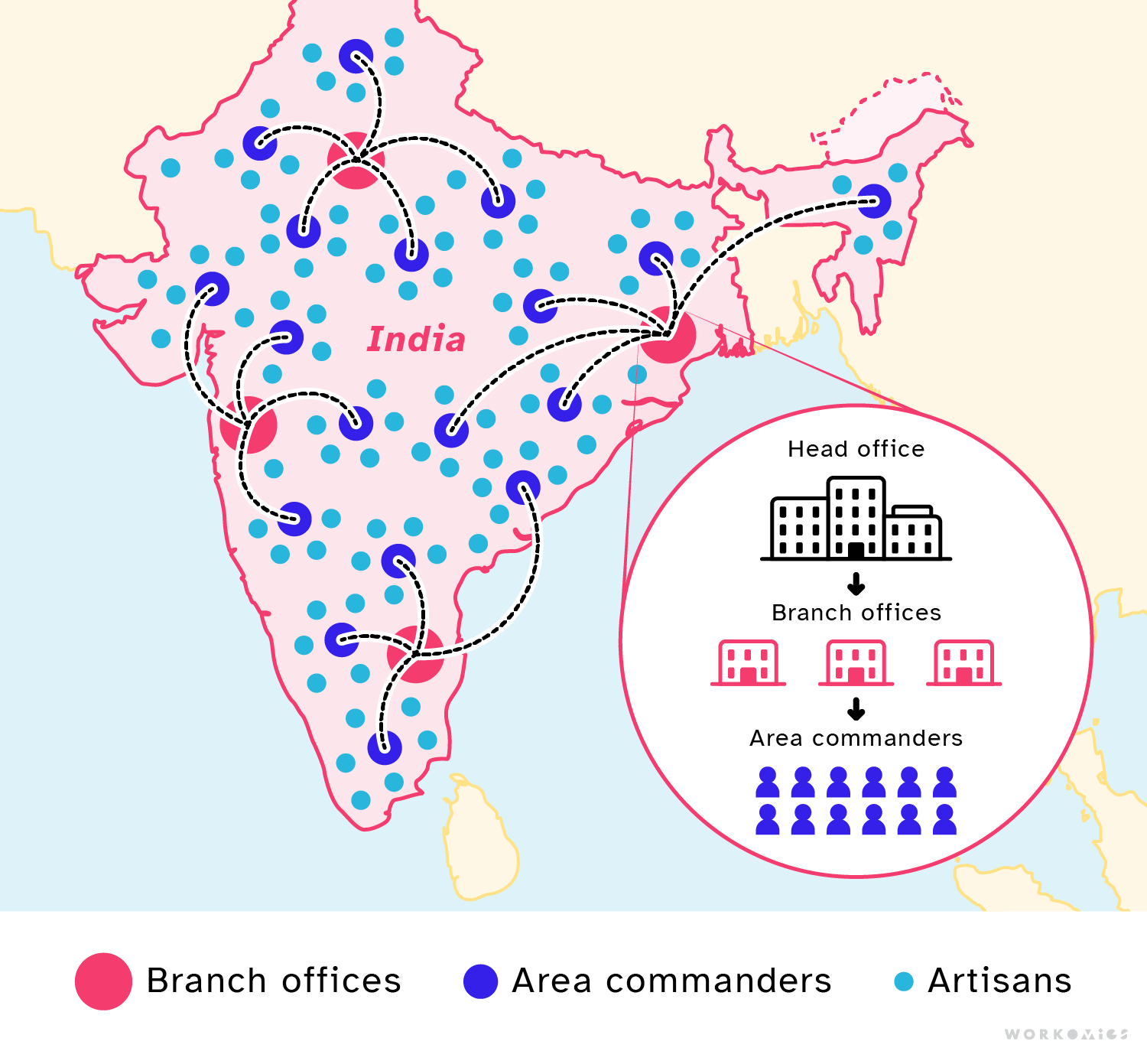
There is a lot of technology built in. Nowadays, we have apps so we can see how far along each rug is, and all that goes into head office. The automation helps it scale. But at its core, it’s a truly human supply chain. We know them by name. We know their families.
WKO: You’re in the business of selling something real and authentic, that also has a deep integration with technology. How do you prove authenticity in the world of AI? How do you convince American customers there is a real difference in the quality of the work and the way the artisans are treated, and that the difference is worth paying for?
AC: I think that the more AI is ingrained in our lives, things like authenticity and human connection will become even more important. Our business is built on those principles, so it’s an advantage for us. But we have to do the work of telling the story.
Last year, for example, a bunch of our clients came to India and we made sure they could go to the villages and see the supply chain first-hand. Every time, they tell me it’s the best part of their trip. They may have seen the Taj Mahal, but having the direct experience of seeing the artisan and product being created is so meaningful.
I don’t think AI can match the empathy and creativity that we bring as humans. That’s what distinguishes us. As a brand we want to continue to lean into that human connection because AI can’t take that over.
WKO: Tell us more about how empathy and human connection with the artisans is fostered through the business.
AC: My dad always believed in the power of human potential. He always said that these women — a lot of the artisans are women — are the most talented managers in the world, and he wanted them to feel proud of the work that they do.
By giving them a dignified wage and educating them, he really helped them see their own potential. Many of these women were not educated, and often their husbands would take their money. My dad focused on getting them to at least a second-grade education where they could open their own bank accounts and control their own money. Then he realized that health wasn’t necessarily a priority in the villages, so he partnered with doctors and hospitals to bring more health education and awareness and better healthcare.
I don’t think he was doing it because he would get amazing work from them. They already did amazing work. He wanted them to feel pride and self worth. That was what really transformed the villages. When one or two women in a village started participating in these initiatives, the other women would see it and want to be part of it.
The biggest transformation is that the artisans have consistent, sustainable income. The number one thing they do with that income is invest in their kids. We have hundreds of stories where the artisan didn’t even know how to read and write, and now their child is a leading doctor.
WKO: How has the US organization grown from the business your dad started?
AC: In 2008, my dad recognized that an artisan supply chain can’t really thrive unless you have the end customer that appreciates the value. We discussed needing to get closer to the consumer in order to continue to evolve our supply chain and make products that are actually resonating with changing needs. That was the trigger for me to come back to the United States to start the US operations. At the beginning, it was me and two other people in a 200 square feet office. I had a little van to do customer deliveries, I took customer calls, I balanced the books. It was really hands-on, building the business ground up.
WKO: How has getting closer to the customer changed your products?
AC: We try to really listen to the theme of what customers are saying, and then make those changes at the artisan level. A great example is CallaLuxe, our new performance rugs. Seventy percent of US households have kids or pets and they want rugs that are easy to clean and easy to live with. We found a special yarn that is made by one factory in the world, and we’ve spent the last four years experimenting with different rug constructions. It’s still 100% handmade, but the new product is really versatile. It can be used indoors or outdoors, cleaned with a little soap and water. It’s still beautiful and soft, but with more of the properties consumers are looking for.
WKO: How do you involve the artisans? How do you get them on board with making a different kind of product after they’ve been doing it a different way for so long?
AC: We work alongside the artisans and we focus on the context: why we’re doing what we’re doing and how it’s important to the business. But also their context, and how it helps them, improves their income, helps to sustain the village.
WKO: Big picture, that’s a trade-off between what’s functional and what sells, versus the art and tradition. How do you figure out which compromises are necessary, and which would dilute the core of what you do?
AC: To talk about the performance rug example, we knew the customers wanted performance. We could have made inexpensive polyester rugs, but we wanted to keep the craft.
You have to innovate and evolve, but you have to define the box you want to be in. Then you experiment within that box. When the customer need evolves, the supply chain has to evolve with it, or the business becomes obsolete. But our business model — the box we have made for ourselves — is to marry the needs of the artisans and the customers as much as possible. The two have to be connected. Teaching the artisans to weave with performance yarn took time. But by teaching them that skill, the artisans are evolving alongside the customer.
WKO: Did you always know you were going to go into the family business? What are the pros and cons of following in your father’s footsteps?
AC: Even as young as seven or eight, my dad would take me into the villages. I remember spending my summers getting up at 5am and going into villages with him and seeing him work with the artisans. I saw what it means to really take care of people, and what my father had built. There was never a spoken expectation, but I developed a really deep passion for the work, so it was very natural for me to join the family business.
In total we are five siblings, and all of us are in the family business, three here in the US and two in India. You’re right that there are always pluses and minuses. Luckily we’re in a place where we have very clear roles and responsibilities. I’ve also learned a lot about how you solve conflicts and differences of opinion. In a family business a lot of things might be left unsaid — hard things aren’t addressed and problems allowed to fester. I’ve learned to make sure we have a good process and a good platform to resolve differences and make decisions.
WKO: You also have to think about the other side of the family business. You remember being seven and visiting the artisan villages with your dad, and you have a seven-year old son yourself. How do you think about your son and the family business?
AC: I don’t have any expectation for him to join the family business per se. I want him to pursue his dreams. I feel that the most important thing my dad gave me was the right values: how I see the world and what I care about. I hope to translate similar values to him.
He’s growing up very differently from how I grew up, so I have to be very, very intentional about it. I share a lot of stories. He goes to India a couple of times a year. The last time I took him to one of the weaving villages and he saw how people live. We talked about how the kids don’t have too many toys. He’s still young, so I don’t think he has fully grasped everything, but I think my role as a mother is to make sure I’m exposing him to those aspects of the world.
WKO: How do you balance your role as a mother with your role as a CEO?
AC: What I’ve found is that there are times when the business needs me and I have to be there, and I need to work hard. And then there are times when my family is a big priority and I have to be there for them. I’ve learnt to be present in whatever it is that I’m doing. If I have an hour with my son, I won’t want to be checking emails. I want to be present and give him my full self.
WKO: That can be easier said than done. It’s hard to be fully present when your phone starts pinging because somebody’s got an issue at work. Do you have a secret decoder key?
AC: I wish I had one! I have built a very strong ecosystem of support in my life. My husband is incredible and we have a nanny. But I also have an incredible team here. I’ve learnt that I need to surround myself with people who are smarter and better than me. I’m the leader of the business, of course. And there are times when fires happen in the business, of course. But when you surround yourself with people who are smarter and better than you, they can take a lot of the load off. You have to learn to let go. You can’t do it all. You cannot.
WKO: You cannot let yourself be indispensable.
AC: A hundred per cent. It’s not easy.
WKO: What does success look like for you personally and for the business?
AC: For me, success is learning and growing, especially as a leader. If I’m not, then I wouldn’t be doing it.
For the business, success has always meant sustaining the craft and transforming the lives of the artisans. Are we helping to improve the incomes and quality of life for the artisans? That is the most critical thing that we measure.
Revenue and profits are all important. We’re north of a hundred million in US revenue, and our goal is to continue double-digit growth and take our products to more designers and more households. But the artisans are the DNA of the business. The end consumer needs to understand the beauty, the meaning, and the quality. We don’t want handmade rugs to become like a Birkin bag, only afforded by a few and everything else is made of machines. That means taking care of the ecosystem and the supply chain in India.
We have to sustain and elevate the craft and the artisan. That is the true measure of success for the business.
Our other ideas worth exploring
Knowing when to start, and stop
Ella Korets-Smith talks about starting two different biotechs, the experience of winding one of them down, and how she prioritizes relationship-building.
Throwing out the instruction book
Melissa Williams, founder of Simply Patient, discusses why patient-centricity can be challenging in pharmaceutical companies, and how she stays laser-focused on bringing patient voices earlier in drug development.
"I want to hang my hat on me"
Krista Lee Hynes, co-founder and managing partner at Ignite Financial, talks about her journey from theatre to financial planning, and why she has always bet on herself.