
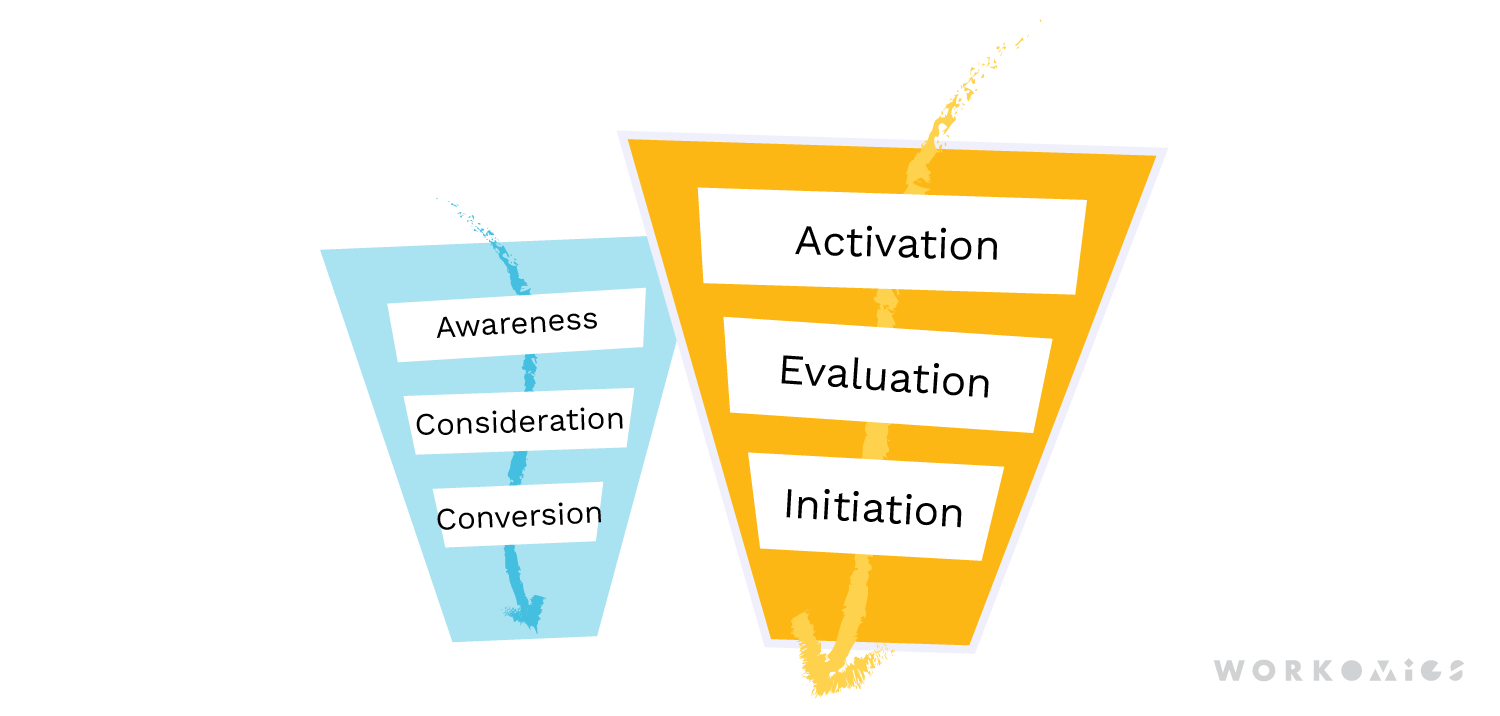
In the classic conversion funnel, we think of customers as moving from awareness through consideration and conversion. When we’re thinking about a patient experience, they are not just any customer, and there are special nuances that need to be captured. We adjust the framework to focus on the patient treatment decision pathway, with three key “stages”:
- Activation to consider a new treatment
- Evaluation of treatment options
- Initiation of treatment
We use this patient-centric framework to help our clients evaluate what the focus of their patient messaging should be, and identify high-value opportunities. It helps us integrate what we know about the particular therapy, disease state, competitive environment, and patient population.
Let’s take a closer look at each part of the framework!
Activation to consider a new treatment
In the “activation” stage, marketing teams provide the trigger for a patient or caregiver to consider a change to their status quo. This might mean prompting a patient to consider a different treatment than the one they are on, or to seek treatment for symptoms they are currently managing by themselves.
In terms of messaging across marketing campaigns, “activation” can show up as the mention of troublesome symptoms patients may be experiencing, ideally backed up by real and relatable patient stories. It can also include the highlighting of disease state-specific information and keywords, so patients can immediately understand they may be eligible for this treatment.
In many cases, activation messages aren’t necessary. For instance, patients who have been diagnosed with cancer tend to be highly activated by the mere fact of being diagnosed. However, in many chronic conditions activation has a much greater role to play, in order to overcome a patient’s natural inclination towards their current symptom management routine. As marketers, our job is to activate them to consider new possibilities.
Evaluation of treatment options
In the “evaluation” phase, the patient or caregiver considers their options, weighing their relative risks and benefits, and working with their doctor to decide on the best treatment option for their unique circumstances.
In terms of messaging across marketing campaigns, “evaluation” can show up as effective communication of clinical trial outcomes and risk/benefit tradeoffs, highlighting key points of differentiation from competitors, or sharing examples of quality of life post-treatment.
Evaluate-focused messaging and campaign elements become more important for a therapy trying to reach eligible patients in a crowded market, while a first-in-class therapy, or a therapy in a rare disease state with few existing treatment options, may focus efforts elsewhere. However, a re-evaluation may be necessary as market dynamics shift and competitors move in.
Regulatory considerations play a big role in the selection of evaluate-focused messaging, and the amount that we can compliantly communicate to patients about clinical trial outcomes can sometimes feel limiting. However there are other ways to effectively communicate why a therapy might be preferable to others already on the market. For example, what about differences in the treatment experience? Would the process of one treatment mean fewer trips to the hospital or a shorter follow-up commitment? These are all questions that patients might weigh as they consider quality-of-life tradeoffs, and can often be emphasized without needing direct head-to-head comparison data.

Initiation of treatment
In the “Initiation” stage, the patient or caregiver takes the next steps to explore the practicalities and logistics around the treatment(s) they chose.
In terms of messaging across marketing campaigns, “initiation” often shows up in the identification of support programs and resources that can help patients and their caregivers with the logistics and costs associated with treatment. It can also include connecting patients to others who have experience going through the treatment process, and sharing patient stories that illustrate practical and logistical elements of the treatment experience.
Many advanced therapies in rare and complex diseases come with heavy logistical burdens for patients in terms of cost, travel, and time away from work and home. These non-clinical barriers can be better anticipated and addressed when brands focus on well communicated initiation-focused messaging. Therapies that are self-administered and easily accessed at local pharmacies have a different calculation here.
Prioritizing Patient Marketing Messaging
In an ideal world, marketing teams would optimize their campaign across all three stages of this framework. But in the world of pharma and biotech, where resources for patient marketing are often constrained, there may be a need to prioritize efforts.
We also have to remember that cognitive overload is something that people experience, especially patients with underlying health challenges. Prioritizing key messages with this framework, therefore, can help focus marketing spend, while also directing limited audience attention to the most important points.
Ultimately, marketing campaigns have two interrelated goals: to reach business objectives, and help make it easier for patients to start and stay on therapy. We find this framework helps us balance business priorities while staying centered in the patient experience. With clearly prioritized messaging, we can make the biggest difference for brands and patients.
Our other ideas worth exploring

Knowing when to start, and stop
Ella Korets-Smith talks about starting two different biotechs, the experience of winding one of them down, and how she prioritizes relationship-building.

A closer look at the investigational drug daraxonrasib
The RAS protein has historically made pancreatic cancer hard to treat. Darasonrasib takes a different approach.

Bedside Manners: How a pediatrician approaches patient education
An interview with Dr. Karissa Young, a general pediatrician, about her philosophies and strategies around patient education.