
Recalibrate ambition
Up until recently, we’ve ascribed to the ethos of setting goals ambitiously. It’s received wisdom in OKR world* that you should set objectives so ambitiously that achieving 70% is a good result. And of course ambition is good — there would be little point in setting goals that are trivial to achieve. But we’ve adjusted our thinking a bit from our ongoing forays into self-determination theory and its concept of optimal challenge:
Optimal challenge means facing demands that most often one can master, rather than ones at the leading edge of one’s capabilities….high-difficulty challenge should, however, be an intermittent element, in which case it can enhance and heighten intrinsic motivation [emphasis ours].
Basically, if we want to stay motivated, we need to satisfy our need for competence, which means that we need to succeed the vast majority of the time. It’s certainly been our experience that if a goal gets too far off track, it’s hugely demoralizing. Case in point: In 2021, Susan, one of the Workomics co-founders, had a goal to complete 5000 minutes of yoga, against which she completed about 3700 minutes. Doing 3700 minutes of yoga in a year might feel amazing if your goal was 3000, but it felt terrible for Susan since her goal was 5000.

Susan's actual progress against her 2021 goal of completing 5000 minutes of yoga during the year.
We think Brené Brown and James Clear articulated a really compelling solution in their recent two–part discussion on Brené’s podcast: choose consistency over intensity. We conflate ambition and achieving goals with this notion of constantly pushing ourselves, but that’s not sustainable. Here’s how James put it on the podcast:
So, going into 2022, let’s dive into Susan’s telling of how she’s taking a different approach to her yoga goal:
I’m changing her ill-fated yoga goal in three ways. First, I’m making it a goal to just show up for yoga at the start of every work day. It can be as little as five minutes, but the important thing is to roll out my mat, turn on my yoga app, and do it. Too often last year, I got derailed because I felt like I didn’t have 90 minutes to spare for yoga, and hitting my goal required longer sessions. This year, I’m aiming for consistency, and giving myself credit for just getting started.
Second, instead of relying solely on a big, chunky 2022 yoga goal, I’m formulating my goal as a weekly target. What I’m trying to do there is combat the fourth quarter phenomenon where I lost all motivation for yoga because the goal was so out of reach. Every Monday, I’ll get a clean slate and hopefully a new optimal challenge.
But I am still keeping an annual total minutes goal — my third change is to aim for a more lower total of 2,760 cumulative minutes of yoga in 20224. I’m hoping that this is where the SDT intermittent challenge will come in. I can satisfy my weekly goal with five minutes a day or 25 minutes a week. To get to 2,760, I need to average about an hour a week5. I’m hoping that by having both a daily habit goal and a cumulative annual goal, I will be more motivated to sometimes do a longer practice. I have no idea if that will work, but we’ll see how it goes through the year.
Check-in frequently
‘Seeing how it goes through the year’ is the most important part of my goals routine. Once upon a time, I used to do a quarterly check-in, but the usual pattern was I had made progress on a handful of the most salient goals, and all the rest garnered, “Oh yeah. I wanted to do that,” followed by continuing neglect.
Over the last year, I’ve gotten religious about checking in on my goals frequently. Anything I only look at once a quarter is actually on my “Someday Maybe” list, and I’m only reviewing it to make sure I’m still okay with making zero progress6. I check into most of my goals daily or weekly, with a few lower-frequency items that I only check into once a month.
I manage all these goals with an app called Strides. It is eye-wateringly expensive as apps go7, but it makes that daily and weekly tracking frictionless. I invest about 30 seconds a day, and perhaps another 2-3 minutes on Sundays, and it keeps all my goals top-of-mind, and all my progress (or lack thereof) tracked and quantified.
I credit daily check-ins for my greatest goal triumph in 2021: walking 10,000 steps every single day. I have worn an activity tracker daily since 2015, and it’s been set with a nominal goal of 10,000 steps that whole time. The result of that passive monitoring was that I achieved my steps goal approximately never. Since switching to daily check-ins in 2021, I have become a dedicated daily walker. Per my step tracker, I walked 50% more than I had in years past, jumping from 2.7-million annual steps to more than 4-million steps.
For me, that happened because those daily app check-ins kept me accountable: I couldn’t fool myself that I was hitting my step goal ‘most of the time.’ Then, once I got on a streak, the steps goal morphed into an optimal challenge. Most days, I find walking for an hour easy and pleasant. But on days when it was -20, or pouring rain, or I was on holiday or on deadline, it was a challenge. Walking consistently when it was easy fuelled motivation when it was hard. Walking on the hard days motivated consistency when it was easy. And now, I guess, I’m a daily walker.
Create context
In 2022, Susan indicated that she is also striving to put her goals into context. This is partly inspired by the ‘goals content’ sub theory of self-determination theory, which says (amongst other things) that achieving goals only results in improved well-being when those goals are intrinsically motivated. Empirically, psychologists see that goals like money, fame, and image aren’t as motivating, and even if you achieve them, they aren’t very satisfying. The difference between an intrinsic and extrinsic goal is a bit nebulous, but it became more tangible when listening to James Clear talking about “identity-based habits” on that Brené Brown podcast:
Identity-based habits is basically encouraging you to start instead of thinking about the result that you want, or the outcome that you’re trying to achieve, start with the type of person that you wish to become.

A better representation of Susan's goals.
So in 2022, Susan has tried to formulate identity-based goals. Specifically, she has declared that she wants to be the type of person who:
- Engages deeply and regularly with new ideas from diverse sources
- Prioritizes long-term physical and mental well-being
- Makes time and space to nurture relationships with my most cherished people
All her small numerical targets ladder up to those three big identity goals, not unlike an OKR structure. By nesting goals like reading and writing; steps, yoga, and sleep under the larger identity goals, the small targets are framed differently, and feel more meaningful.
Here, Susan further describes the advantages of this framing:
I also love how this framing encourages me to have a wider variety of targets. I’m a fairly goal-oriented person,9 and the trap I fall prey to is feeling the antsiness of inefficiency if I’m not pursuing some goal, any goal. A less pathological solution would be to just not care so much about the damn goals, but historically, I’ve not had much success with that. By contrast, having goals for things like ‘take my children on outings’ or ‘watch TV,’ or ‘put your phone away for 2 hours at the end of the day’ helps keep some of my Type A-ness at bay. This sounds ridiculous, but what happens is I check in with my goals, see that I’ve made no progress on watching Ted Lasso, and then I go do that. The desire to get the gold star for not looking at my phone (sometimes) overpowers my desire to get a gold star by answering an email.
Our hope for you reader is that you are not so afflicted with goal-orientation and careerism as to need goals for having fun. But if you do tend that way you might find that having a goal of ‘10 summer evening trips for ice cream’ changes your life.
*The O in OKR stands for objective, which is the priority you want to achieve. KR stands for the key results you will measure to assess progress against your objective. Normally you set OKRs for important goals that are in danger of being crowded out by urgent tasks and pressing deadlines.
Our other ideas worth exploring
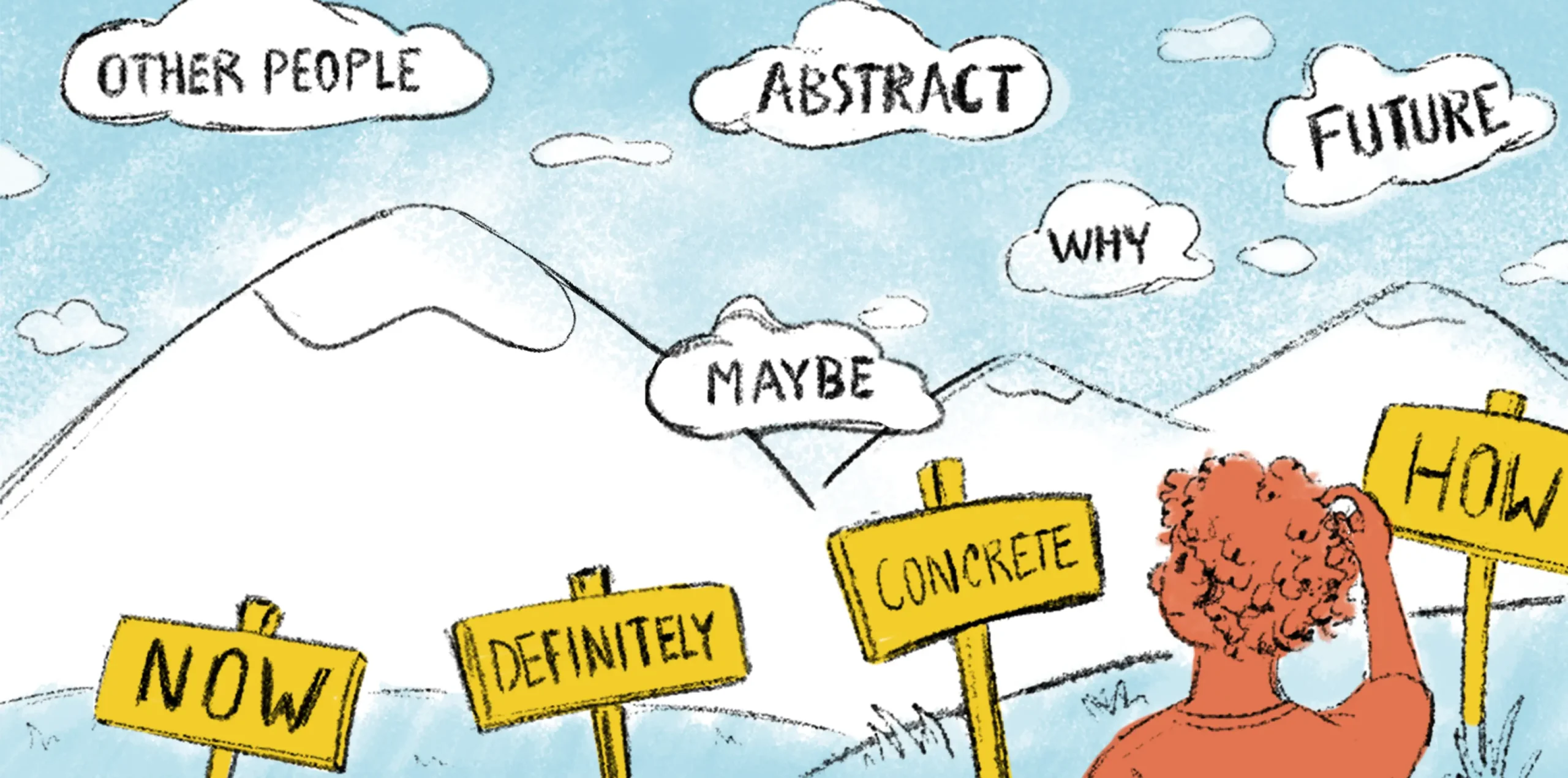
Co-creation helps stakeholders think about the details
Introducing Construal Level Theory (CLT) and its implications for how we use co-creation to support change management with stakeholders.

Mailbag: social change and career choice
An examination of practical ways to evaluate social impact opportunities without sacrificing your career stability.

Three principles to make AI work for people and teams
Our thinking of how to implement AI in the workplace in a way that elevates employee well-being, workflow, and team collaboration.