
The customer journey map is nearly ubiquitous in the modern enterprise. Historically, companies were organized around functions (customer service, supply chain, billing), or individual products and services. The result was that when customers would deal with large companies, the experience would be disjointed. The person helping you with your mobile phone couldn’t do anything about your Internet, even though it was the same company.
The journey map was intended to help with that problem by creating a single, unified model of the customers’ experience. By aligning to the customer journey, all the disparate teams working in different functional areas on different products or services could be contributing to a unified, consistent experience. The goal was to make things better for customers, while also creating efficiencies for the organization by reducing duplication of effort across big organizations.
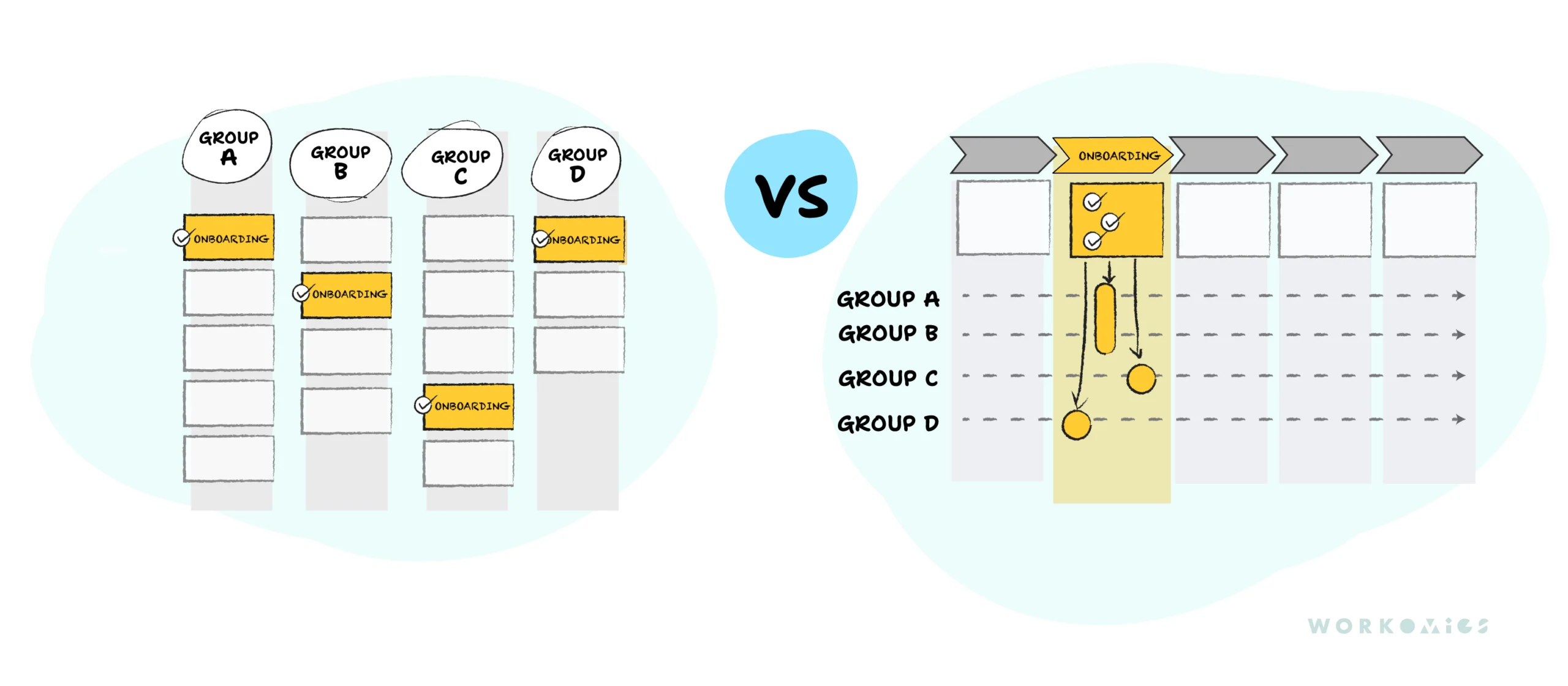
So far, so good. The customer journey is a useful construct. Within organizations, there’s an unfortunate tendency to narrow our attention to our own scope and be a bit oblivious to interdependencies elsewhere in the organization. Journey maps are a tool that helps us look left and right, connecting dots across silos, making sure our work is aligned with work elsewhere. Today, it’s much more common that you can call your bank and the same person will help you sort out your credit card and your savings account. Journey maps were a tool that helped that happen.
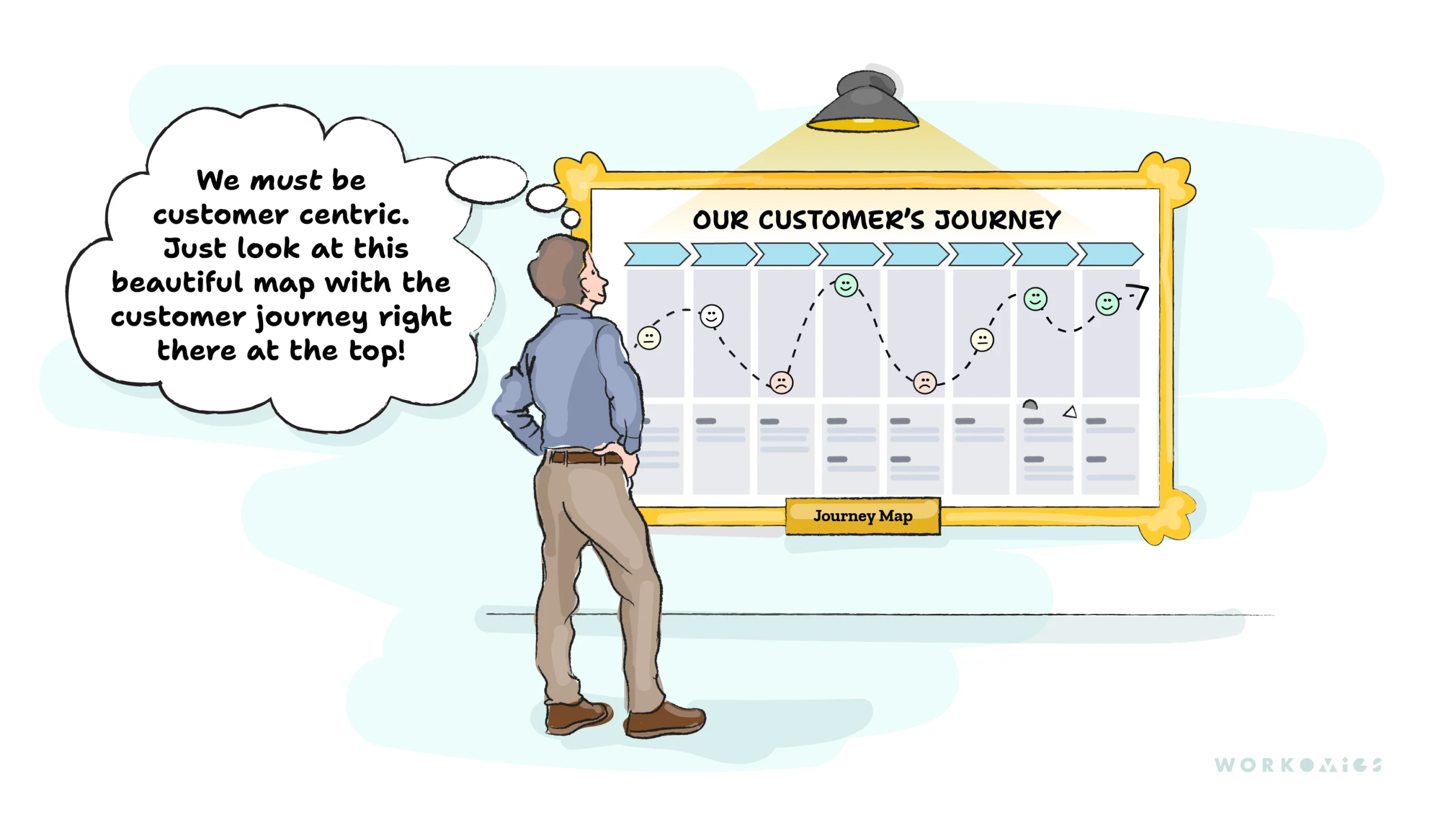
But somewhere along the way, the journey map morphed into something else. Journey maps became evidence of customer centricity, rather than a tool to enable it. They became bludgeons to enforce organizationally-driven standards by overzealous maintenance of existing maps, without regard for variation in customer needs. It didn’t happen in every organization, but often enough that any journey map now deserves skepticism. Is this a journey map that is truly in service of the customer? Or is it customer-centricity theatre?
A typology of journey maps
There are actually two different kinds of journey maps that serve two different purposes.
- The Journey-Map-As-Alignment-Tool is primarily a communication tool for translating across functions.
- The Journey-Map-As-Problem-Solving Tool is primarily a tool to visualize information, clarify a problem space, and find solutions.
Maps as alignment tools
If you’re building a map as an alignment tool, the objective is to help everyone in the organization put their work in a customer-centric context. These maps have a broad audience, and it should be relatively consistent over time. An organization doesn’t need to have one map to rule them all, but there should be relatively few, and they should be simple and memorable.
The analogy here is the map the cruise ship company uses to sell you on an upcoming voyage. They are glossy. They help you understand why these destinations are important and what makes them desirable. However, they leave out a lot of complexity in order to do the job of communicating.
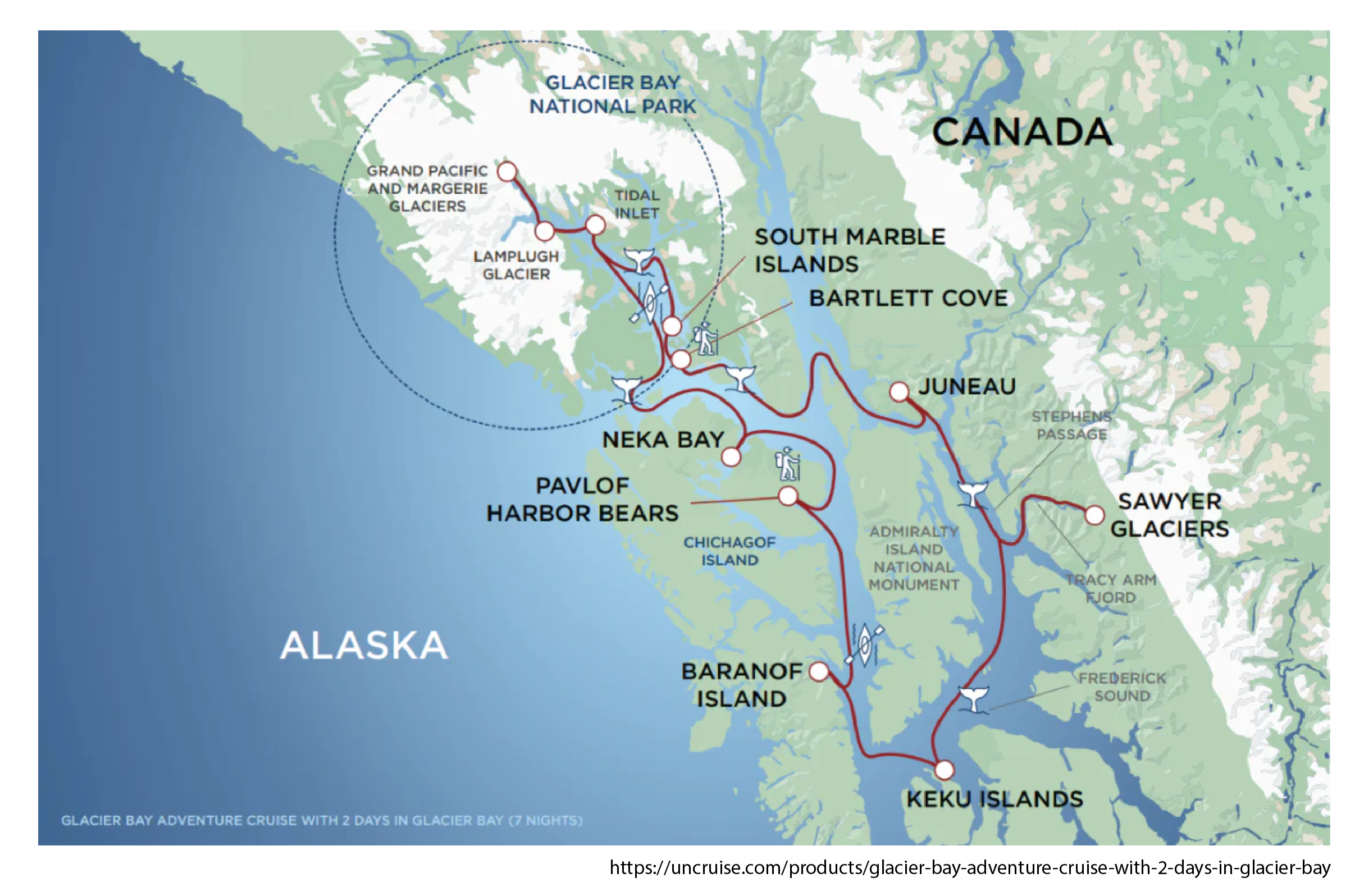
If you are a biotech, you might build a map like this for the patient journey, highlighting the various hurdles and milestones patients and caregivers must navigate in order to receive your therapy. If you are embarking on an AI-driven transformation, you might create one so that the many different functions involved can remain focused on the customer value opportunities, rather than technology capabilities.
You would be right to insist that everyone align to the big picture of the map, and that it not be changed on a whim. Whenever many stakeholders need to be on (and stay on) the same page and have a common language to bridge different groups, a Journey-Map-As-Alignment-Tool is a valuable construct.
But having one journey map to outline the big picture and bridge different groups does not mean your Journey-Maps-As-Alignment-Tool is the be-all and end-all. Certainly, some of the cruise ship stakeholders will never need a map more detailed than the one in the brochure. But up on the bridge, we want the captain and crew to be using proper navigational charts.
Maps as problem-solving tools
What the captain and crew need is a map that helps them solve their very specific problem in their very specific role. They need a map-as-problem-solving tool. Like navigational charts, the audience for such maps is typically very narrow, and might require specialized knowledge to interpret. Unlike their alignment-map cousins, simple and memorable is not important. These maps should be fit-for-purpose, in the sense that they get you where you’re going.
The London Tube map is iconic. It’s incredibly effective for navigating London underground. It’s also next to useless for getting around above-ground on foot or in a car. That isn’t a shortcoming of the Tube map; it’s a metaphor for what a problem-solving map should be.
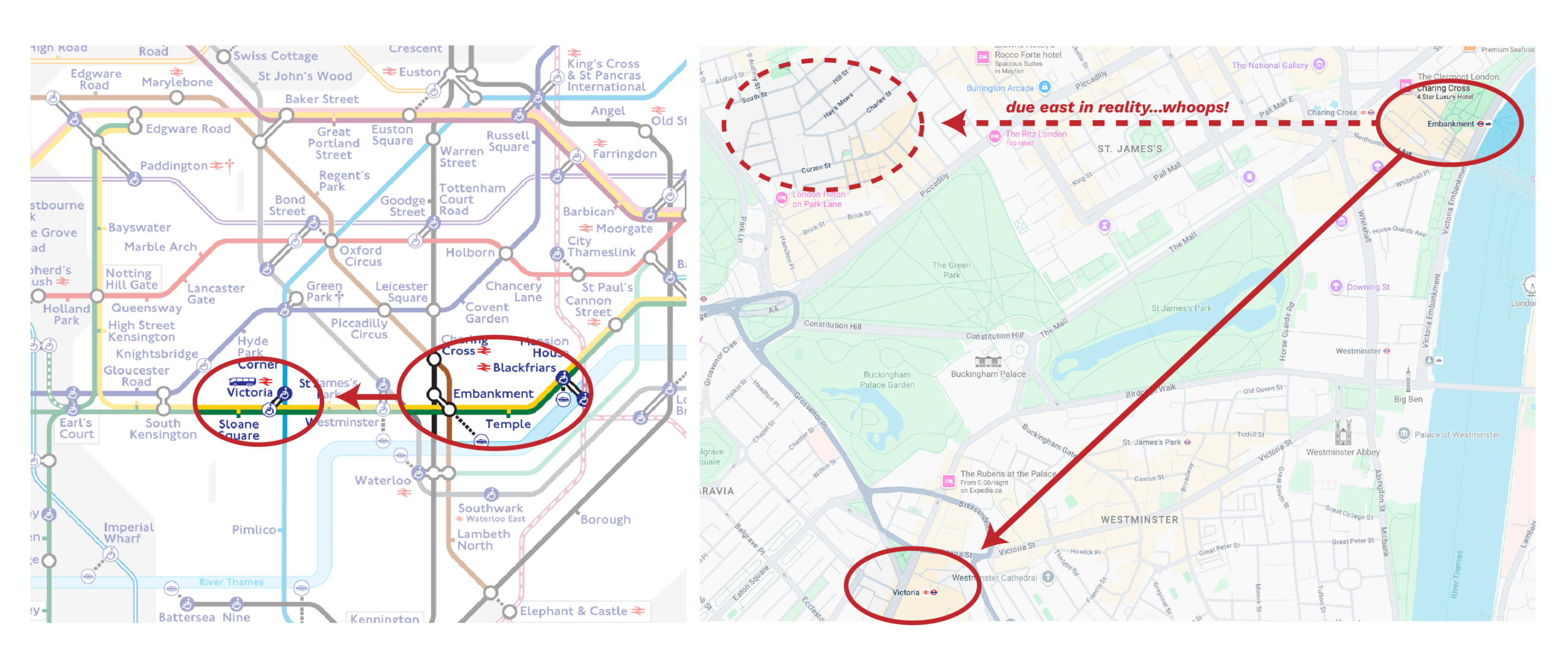
To create a useful map, you must make choices to simplify real-world complexity and emphasize important relationships. In the case of the London Tube map, the designer chose to abstract the relationship between tube stops and cardinal directions, in order to better represent things like transfer points and fare zones. The same thing happens when you make a journey map as a problem-solving tool. You will abstract certain things and emphasize certain relationships, in service of the problem you are trying to solve.
The trouble begins when the map is complete. It almost certainly took a lot of effort and represents a lot of excellent thinking and new insight. Understandably, you want to show it off. But maps carry a certain organizational cachet, so as soon as you start sharing it more broadly, it becomes a quagmire. Other stakeholders experience your map as wrong and possibly dangerous. Imagine the Parks Department looking at the Tube map. You’ve removed all the parks! Does that mean you don’t think parks are important? That the parks department doesn’t do valuable work? Of course, it just means that the parks aren’t very relevant for the job of planning a subway journey, but that’s not how people experience it when they see their core contributions. unrepresented.
Let a hundred journey maps bloom
The answer to this problem is to be clear on the distinction between alignment maps and problem-solving maps. For the latter, eschew standards and let them propagate at will. The value of a problem-solving map is largely in the mapping process — figuring out and visualizing what is salient for the problem space. The outputs should be as different as the problems themselves. Only the alignment maps have value as an ongoing artifact, helping keep teams on the same page, as they go about their more detailed work.
If we’re making a map for the experience of cancer patients, it’s very important to capture patients’ emotional and physical well-being. If it’s the journey for renewing your cellphone, probably not so much. If the problem you’re trying to solve is how patients’ safety questions get addressed through the call centre, and you’ve only got a map of the full disease journey, the map is not going to help you. You may as well try to navigate the streets of London with a globe. The reality is that organizations will end up, eventually, with all kinds of different maps, and for the most part they won’t fit together to form a coherent whole. That is okay.
Organizations put entirely too much effort into creating, maintaining, and organizing, rather than treating journey maps as tools to get a job done. You spent a lot of time making the map, but the valuable output is the problem that you solved, not the map itself. It follows that most maps should be much less beautiful. The truth is that most of the time, we should be making, ugly, low-fidelity maps, with sticky notes and markers, or on a Google spreadsheet. That helps clarify that their role is as problem-solving tools rather than the loftier, big picture maps serving as alignment tools. Their audience is limited to the team of people directly working on the project and their usefulness expires once the project is done.
Although historically a tool for big organizations with silos to bridge, the truth is that organizations of every size benefit from journey mapping. Whenever you have complex, multi-faceted, multi-stakeholder problems to solve, mapping can make it easier to find creative solutions. Just be clear on the kind of map you’re building, and use it thoughtfully and with purpose.
Our other ideas worth exploring

Patient-centred communications in pharma and biotech
The Universal Patient Language (UPL) is an example of how a pharma company can create effective patient communications.
Treatment Decision-Making: A Framework
Commercial pharmaceutical teams should examine an array of factors that shape treatment decision-making to influence prescribing behaviour.