
This installment in the Women’s Entrepreneur Series is an interview with Melissa Williams, the founder of Simply Patient. With Simply Patient, Melissa applies her expertise from 20 years in biopharma to help biotechs incorporate patient voices earlier in the development of new drugs. They focus on working with teams at two different stages: (1) very early on, when decisions are being made about clinical trial design or portfolio investment, and (2) in the 2–3 years leading up to a drug being approved and launched, when there is an opportunity to engage with patients on a larger scale.
In this interview, Melissa talks about the mission of Simply Patient, why patient-centricity can be challenging in pharmaceutical companies, and how she stays laser-focused on bringing patient voices earlier in drug development.
WORKOMICS: Prior to starting Simply Patient, you worked for 9 years at Genentech. How has the experience of working at a large biotech shaped the choices you’ve made in setting up Simply Patient?
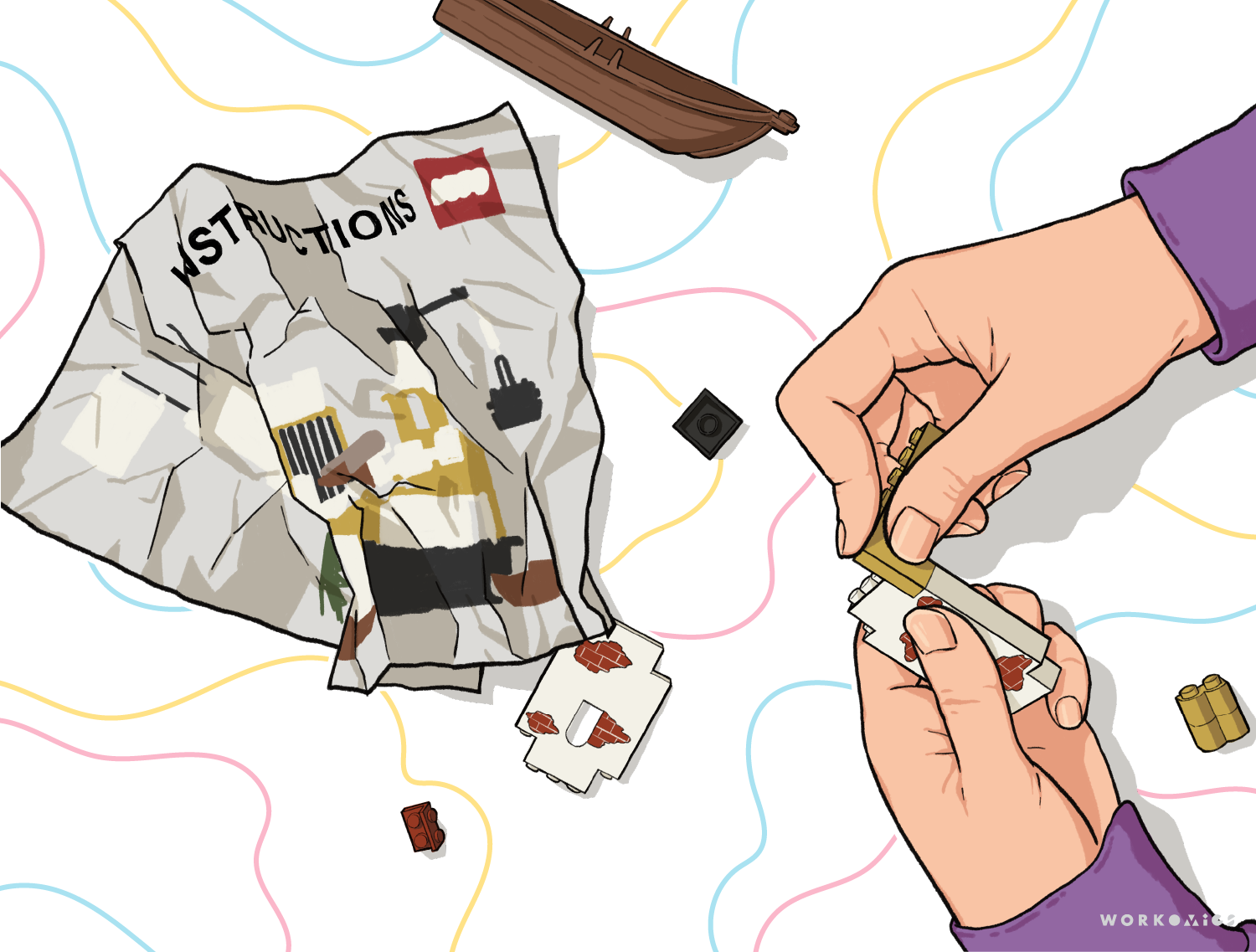
Melissa Williams: I recently stumbled across my college admissions essay to MIT, and I was shocked how much it still rang true. In that essay, I described my approach to Legos: first follow the “standard” approach according to the instruction book and then throw out the instructions and build what feels right, feels unique, feels interesting.
Genentech was an extraordinary place to learn a “standard” approach in the company that literally formed the biotechnology industry. I got to work across a broad swath of groups: insights and analytics, marketing, and patient services. Between my experience at Genentech, Ultragenyx, and management consulting, I started to see how the Lego pieces of patient engagement could be put together differently.
I’m a systems-thinking nerd, so it was fascinating to see how the various parts come together (or didn’t). All too often, Lego pieces placed years earlier limited what was possible for patients. I formed Simply Patient to change that. To go back to my admission essay, I took all the things I learned from the “traditional” approach, and I formed a company to put the pieces together in new ways and help teams take a better approach into the future.
Often, that starts with doing less, better.
WKO: Can you unpack that for us? What does it mean for a biotech to “do less, better,” in the realm of patient centricity?
MW: Now more than ever, teams are stretched: stretched for time, stretched for budget, stretched for focus. I love helping teams focus and see which patient inputs are worth prioritizing sooner than later.
That really matters in biotech because of the timescales. In tech, you can swap in a software feature and A/B test. In developing medicines, you’re making choices and you won’t have the data on how it worked for five or ten years. When you’re making that kind of one-way door decision, how do you bring in patient voices to make the best decisions as early as possible?
So many of these decisions are made by scientists and clinical researchers. They are often extraordinarily good at thinking about the disease and its mechanisms. They can make assumptions about what patients care about, but they don’t have the lived experience of a 3am wake-up, worrying over an agitated child, or the logistical headache of managing a complex disease alongside two other school-aged children.
One of the most powerful ways for drug companies to tap into the patient reality is through partnerships with patient organizations. Patient organizations represent the collective voice of larger groups of patients.
It’s not just stories though. The trick is bringing in the right patient inputs at the right time to meaningfully shape the trade-offs that inevitably arise in drug development. That can be anything from drug candidate design to clinical trial design. All too often, teams discover that their assumptions were wrong when trials fail to enroll enough participants. Involving patients earlier helps get ahead of costly delays.
In the spirit of helping teams focus, we’ve been working on a book that will be published next year. The book is a guide for patient organization leaders on how to partner with biopharma in mutually beneficial ways. Drug development needs patient voices, and this guide will make it easier to focus on what matters earlier.
WKO: People working in pharma and biotech are overwhelmingly motivated by wanting to help patients. So why is it so hard for organizations to translate that into practice? Why does it break down?
MW: It’s a system-level challenge. Individuals advocate to bring patient voices into their programs, but imagine that individual in a high-pressure environment where budgets are constrained and teams are shrinking. Relying on individual advocacy in that moment is hard. The industry is evolving. Thirty years ago, patients were “subjects,’ while today, patient-focused drug design is the regulatory expectation. However, even with that expectation, large, complex systems are slow to evolve.
When large, complex systems are slow to evolve, how do you change? One approach is intentional milestones. For example: in order to submit your phase two protocol for ethics review, you are required to have patient input on the endpoints [the data you are collecting to determine if the medicine is effective]. When we have that kind of specific milestone, patient centricity becomes the way business is done.
The small companies are doing cool stuff in patient centricity. They have the flexibility and the courage. One company that I really admire is Argenx. They made a choice that I think should be industry-standard: they combined patient advocacy, patient marketing, and patient services under one executive. In doing so, they intentionally brought together the silos that are patient-related into one decision maker. Cohesive patient experience is all the easier with cohesive decision-making. I think it’s fabulous.
WKO: How does human‑centred design show up in biotechs, and how can it be more useful as a discipline within that context?
MW: If the “what” we focus on with Simply Patient is bringing patient voices earlier, the “how” is by getting disparate people moving in a common direction. For that, human-centred design becomes an inherently practical tool to achieve those outcomes. It provides a framework for diverging and capturing all the different perspectives in the room. Then it provides the framework for converging, so that collectively we can agree on the needs and the priorities to make better decisions and move together in one direction.
The other element I find so powerful is the separation of problem definition and problem solving. It is so easy, when you’re moving quickly, to jump into problem-solving, and that is when the patient tends to get left out. By treating problem-definition as a separate step, you stay focused on who you are designing your solution for. That keeps your work grounded in patient needs and realities. People who have been through a process and really believe are better able to articulate the “why.”
WKO: How do you keep your focus on patients and rare disease? How do you handle it when you get requests that are from outside your focus area?
MW: In the first year of Simply Patient, I was approached by a former colleague who wanted my help, but it was focused on prescribers, not patients. I could help, but it was outside of where I wanted to focus the company. That was the first tangible point where I had to put my money where my mouth is and walk away. It meant continuing to burn through the runway of what I was investing in the business, and I’m so glad that I did.
It really embodied the bigger mission: I formed Simply Patient to help biopharma get patient voices earlier in drug development. As it became the reality of how we spend our time, which made it easier in future conversations to continue to say, “This is what we focus on.”
We are more flexible when it comes to rare vs. specialty diseases. Our approaches and tools transfer well across specialized, complex conditions and competitive markets. That said, despite having years of experience in diabetes, I probably wouldn’t work in that disease state. The need for patient voices in drug development is the same, but the tools to reach millions of people are very different.
WKO: What has been surprising or unexpected about these first four years with Simply Patient?
MW: I think the biggest joy, challenge, surprise, delight, has been who I have become as a result of creating Simply Patient. I am still myself (like that early MIT admissions essay), but it’s like I’m meeting different parts of myself. It’s such a fun experience to get to do my life’s work on something that is so deeply meaningful and do it in a way that is so deeply personal. I look forward to the future where I get to look back and see how the decisions we shaped play out better for patients thanks to our work.
Our other ideas worth exploring
A new comfort zone
Shiri Levy, co-founder and Chief Scientific Officer at Histone Therapeutics, talks about building a biotech to bring a genetic medicine to market.
Running shoes designed for women
Lindsay Housman, CEO of Hettas, talks about researching and designing a running shoe specifically for women, along with her philosophy on flexible work, and the challenges of fundraising as a female founder.
A business in transition
Rebecca Chan, owner and creative director of Rebecca Chan Events, talks about transitioning her business from weddings to corporate marketing.