
Last year, some psychology research concluded that there is an optimal amount of discretionary free time for our subjective well-being. In general, people are happiest if they have between two and five hours of discretionary free time every day. What’s interesting about this research is that they’re not just looking at the work you do for pay, but all the responsibilities in your life, from childcare to going to the dentist. Discretionary free time is waking time “a person spends in a day doing what they want.”

Adapted from Sharif, Mogilner, and Hershfield (2021). It’s worth noting that their study showed the concept of “too much” free time only applies to solitary, unproductive time. If you are being social and/or productive, you can’t really have too much!
The ideal workweek then, is not some universal magic number, but rather a function of all the other obligations you have in your life.
Imagine someone is in a period of their life when ‘other obligations’ is pretty much a full-time job unto itself. For sake of argument, let’s look at typical weekdays:
- 8 hours to sleep and like, shower, dress, and brush their teeth
- 6 hours of child wrangling and chores
If that person were to work, say, 28 hours a week, then they would average 3-3.5 hours of ‘discretionary free time,’ and be right in the researchers’ target zone for happiness. If they work more than 40 hours a week, then they fall below their 2-hour happiness cut-off.
But many people in this position are not sitting around enjoying 3 hours of discretionary free time a day. Most weeks, they work ~35-40 hours, and can just about squeeze two hours of free time each day. The curious thing is how hard it is to keep work inside a 40-hour box. On any given workday with any given to-do list, it feels reasonable and necessary to trade away happiness for a few extra hours of work. What’s up with that?
The pressure to overwork
We won’t pretend this is a comprehensive list, but for our money, these are four main drivers of long hours for knowledge workers.
1. We anchor ourselves to the way we worked early in our careers
Early career is a really singular time. For most of us, it’s the steepest part of our career trajectories, so extra time pays disproportionate dividends — skills acquired, relationships built, promotions and raises earned. It’s also the time in life where we’re least likely to have responsibilities outside of work. And the energy! It’s easy to imagine someone in their 20s flying across the continent on a business trip, work 12-hours days, and still go out on a Friday night.
In early career the benefits of long hours are greater and the costs of long hours are less. As we age, those trade-offs shift, and the pay-off for longer hours is increasingly less attractive. But because of anchoring effects, the way we work(ed) in our 20s and early 30s defines what we think working “should” look like for the rest of our careers. In reality, those early career years are an enormous outlier, and we should treat them as such, rather than a standard to be maintained.
2. Greedy jobs distort individual trade-offs
Greedy jobs pay disproportionately more on a per-hour basis the more hours you put in. In a greedy job (consulting, banking, lawyering, corporate, high tech, etc.), if you work 60 hours a week, you don’t just make double someone working 30 hours a week, but 3, 5, 10 times as much. The compensation structure pushes people towards longer hours and less free time. Moreover, greedy jobs often don’t exist at 30 hours a week. Even if you were prepared to work 50% of the hours for 20% of the pay, you can’t. We think the counterfactual is instructive here. In Canada, the number of family doctors has outpaced population growth, but there is still a family doctor shortage. Family medicine is not a greedy job — you make the same ~$80 per visit whether you see 40 patients a week or 400. Given the ability to make a good living with less punishing hours, it’s no surprise that many family doctors are choosing time over money.
3. The housing affordability crisis incentivizes longer hours
In major cities where knowledge jobs are concentrated, housing prices are out of control. Recent analysis from the Globe and Mail showed that affording the average home in Toronto requires a household income of $232,000 and eight years of saving for a downpayment. But it’s actually worse than that. Eight years ago, the average price of a Toronto semi-detached house was $625k. Today, it’s more than $1.3M*. For that couple who started saving eight years ago, they’ve been on a saving treadmill. They won’t get any closer to buying a house unless they can increase their savings rate faster than the pricing houses increase. If you’re wondering why there is this cliché of millennial workers who want raises and promotions every six months, look no further. It’s a rational response to seeing your very reasonable goal to own a modest house get further and further away. And of course, at the margin, those dynamics make you more likely to work longer hours — especially if your job is greedy and there are disproportionate returns to doing so.
4. A corporate arms race to optimize business operations
The ethos of the modern workplace is optimization: can we do more, can we do it faster, can we do it with less. Consider the legal profession. In 1962, the American Bar Association said, “there are approximately 1,300 fee-earning hours per year.†” Today, big corporate law firms have expectations closer to 2,400 hours per year.‡ To be sure, this is partly a greedy jobs story — compared to 60 years ago, those corporate lawyers work 70% more hours and earn 300% more money§. But it’s also a story of organizations having a singular focus on short-term, financial outcomes, to the exclusion of all else. Roger Martin calls it surrogation, where we are so focused on optimizing a proxy measurement (e.g. stock market price) that we lose sight of the true outcome (e.g. value of a company). E.F. Schumacher calls it economic thinking, where we allow money generated for individuals to become the overriding gauge of worth. Whatever you call it, the problem is that more ephemeral qualities like resilience (Martin) and human flourishing (Schumacher) don’t show up on a balance sheet. Therefore, organizations put almost no weight on the hours and effort it takes to create an output. If we have produced more and sooner, that is success, irrespective of human costs. Organizations never ask if we should produce less or later to afford workers a more sustainable pace.
Countering overwork at the organizational level
It’s almost impossible for individuals to swim against the current of overwork. Only at the level of organizations or whole societies can we set norms and expectations that can effectively counter the pressures to work ever-longer hours.
For an organization, it’s a delicate balance. Long hours are not always a problem to be solved. It’s hard to achieve excellence without putting in significant, sustained effort. Deadlines are helpful tools that force you to prioritize your efforts, avoid navel gazing, and put real things out into the world, because they create pressure to do more work within a fixed period of time. But it’s equally true that above a certain threshold, there are diminishing marginal returns to putting in more hours. You can achieve more raw volume, but you make more mistakes, work more slowly, and your capacity for creative, generative work disappears almost entirely.
In our organization, we’re really trying to create a culture that prizes excellent work without incentivizing overwork. Especially as we plan out 2023, we’re taking a four-pronged approach to keeping workloads manageable.
1. Privilege resiliency when staffing people to work
If you have 150 hours of work to get done in a week, how many people should that take? If you’re Goldman Sachs you might say two, but most people probably think 150 hours translates to work for four people, since that’s a little less than 40 hours each.
Because we want resiliency, we think about it differently. If we have 150 hours of work to do in a week, we try to assign five people. Here’s why:
- Humans systematically underestimate how long tasks will take. So if we think it will take 150 hours to get something done, chances are good it will actually take 165 or 180 hours.
- Employees spend time on a lot of extra things that aren’t core to their productive work — goal setting, expense reports, all-hands meetings, training. Those tasks all take up real time, but are rarely accounted for when we estimate how long the work will take.
- People get sick. Their kids get sick (or have school strikes). Their cars need repairs. They go on vacations. We tend to treat these things as exceptions, but once you’ve got more than 2–3 people, chances are someone is not able to contribute fully in any given week.
We want there to be redundancy in the system. If 150 hours turns into 180 and someone goes down with an illness or whatever, the four remaining people would have to work 45 hours to get things done. That’s busy, but not unmanageable. If you had started with only 4 people, your remaining three people have to put in 60 hours each. Much more difficult

2. Be deliberate with our operating model to streamline communications
The downside of staffing redundancy into projects is that you add additional overhead for communication and coordination. Conventional wisdom says that while the size of your team grows linearly, the complexity of communication grows exponentially.

Above: A five-person team has 10 lines of communication, compared to just 3 for a three-person team; Below: Some ways of organizing a five-person team without exploding the lines of communication
Conventional wisdom is not wrong! Communication and coordination get harder as teams get larger. But sometimes the work is so complex or the timelines are so aggressive that you just can’t get it done with a duo or a trio.
But that doesn’t mean your five-person team is doomed to spend half their time in meetings. Instead, we are focusing on getting very specific about who is responsible for what and what they need to know to be successful in their role. The idea is that by thinking carefully about roles and knowledge transfer, we can create more streamlined operating models, with less overhead for communications and coordination.
3. Be conscious of how many days are available for work
The default in a lot of organizations is to operate as though there are 260 work days in a year — 52 weeks a year, 5 days a week. That is not reality. You have official holidays, but also, how much work gets done on December 28th? On the Friday before a long weekend? What about the week of the company off-site?
For 2023, we have proactively blocked off ~30 non-working days. These days are hugely important as a release valve. They mean that when work gets intense (and it will), it doesn’t feel as relentless, — there is a break coming. Will we sometimes catch up on work on those buffer days or take the odd meeting during an office closure? Sure thing. But even when that happens, the non-working days have still done the work of creating space to breathe.

Workomics has about 30 non-working days each year, made up of statutory holidays, office closures (one week in the summer and two weeks at year-end), a few days for off-sites, and a few “buffer” days attached to long weekends.
4. Be absolutely fanatical about high standards and deadlines
We are deliberately creating a lot of slack in our system. But that shouldn’t be construed as being lackadaisical about the quality of the work or fuzziness around timelines. The flipside of building in release valves and redundancy is that the work has to be delivered when we say it will be, to the calibre we expect. Everyone gets grace, but nobody gets exceptions.
The goal of all of this is not that no one ever works over 40 hours a week. Sometimes, you have to make a big push and put in those extra hours. What we’re aiming for is an environment where most of the time, most of us are working 35-ish hours, so that at baseline everyone is getting the free time that is so important for well-being. Then, when those intense weeks hit three or four times a year, we can deliver our deadlines, and still have the reserves to move the next big rock up the hill.
*Data is from here. Toronto’s housing market is particularly obscene. Houses in the furthest flung suburbs are more affordable, but the rate of price increase has been just as bad, if not worse. Ajax, a bedroom community about an hour from Union Station saw the average price of a semi-detached jump from $385k to $811k. Someone who started out wanting to buy a $625k house in Toronto would find themselves priced out of the suburbs eight years later.
†28 hours a week with 5.5 weeks of vacation/holidays.
‡48 hours week with 2 weeks of vacation/holidays.
§All of this data is from Daniel Markovits’s excellent book The Meritocracy Trap, which is a comprehensive, data-filled exploration of the ways meritocracy unravels individuals and society.
Our other ideas worth exploring
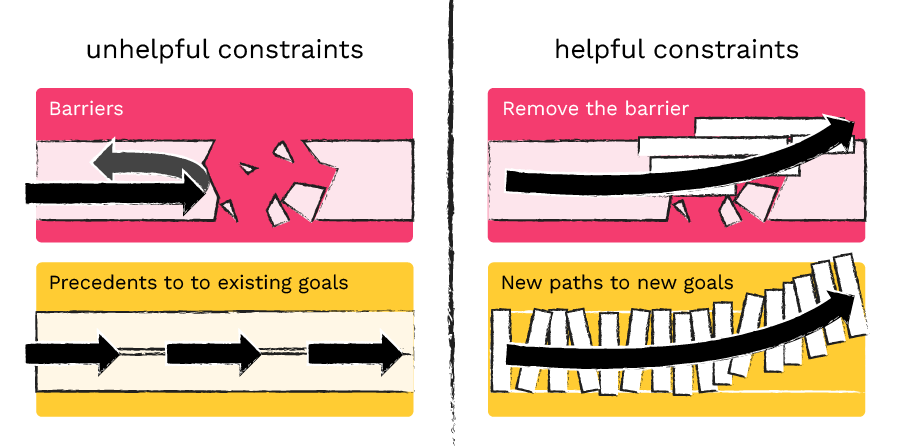
Calibrating constraints
A discussion about the nature of constraints at work, focusing on their benefits and drawbacks, and tips for working within their bounds.

Co-creation and the ownership effect
An examination of the challenges of balancing paid work with caregiving responsibilities, with suggestions for how to create a caregiver-friendly workplace.

Caregiver-friendly workplaces
An examination of the challenges of balancing paid work with caregiving responsibilities, with suggestions for how to create a caregiver-friendly workplace.