
There’s a weird disconnect in how we talk about jobs. On the one hand, it’s received wisdom that people will have many different jobs over the course of their careers (12–15 is the range normally cited). Average job tenure has been on a steady decline since at least 2010, and the most recent US BLS survey* found that average work tenure has fallen below five years overall, and to 2.8 years for 25-34 year olds.
But in too many organizations, employers and employees alike tend to default to an outdated jobs-for-life framing. Employees feel like it’s verboten to talk about moving on, and don’t raise the topic until they tender a resignation letter with two or three weeks’ notice. Employers rarely provide advance notice about the organization changing direction and needing different skillsets, and they certainly never signal changing financial conditions until the layoffs have happened.
This status quo doesn’t serve anyone well. For employers, receiving two-to-three weeks’ notice is not nearly enough time to find and train someone to backfill a role. Employers are left scrambling, as are the teammates who have to cover on the now-shorthanded team. For employees, termination of employment comes without time to bolster savings, re-calibrate household spending choices, or job-hunt from a position of strength. (Ex-)employees are likewise scrambling, needing to come up with a new plan on short notice and often under great stress.
The Status Quo for Ending Jobs
When it comes to employee-initiated departures, you do see workplaces where the status quo is shifting. In these organizations, there is a lot of open and transparent communication about long-term career and life ambitions that extend beyond the current organization, and mutual trust that you won’t be penalized if you tell your boss you’re thinking of moving on. It takes a lot of hard work, a lot of manager training, and a lot of unlearning of old mental models to create that kind of culture. Even in those cases, there tends to be radio silence when it comes to interviewing and accepting a specific new role. But if an organization prioritizes creating a culture of trust and transparency around career progression and outside opportunities, you actually can get to a place where moving on is seen and as a natural and healthy part of the employee lifecycle, and the employer doesn’t focus on retention so much as proactive management of inevitable staff turnover.
When we look to employer-initiated departures†, it’s a different story. Outside explicit fixed-term contracts, it’s rare indeed for an employer to talk about a job having a shelf life‡. Instead, we label jobs as being “permanent” full-time, while knowing they can be terminated at any time for any reason, or no reason at all. Employers don’t try to communicate clearly how or when a job might end, but instead focus their energies (and paperwork) to limiting costs and legal risk§ in the (not unlikely) event they need to terminate employment.
It seems to me that this approach is suboptimal on several fronts:
- It disproportionately disadvantages anyone who is less familiar with corporate environments (typically employees who are younger, racialized, or working in lower-skill, non-union jobs) and therefore aren’t as well-equipped to navigate employment and termination negotiations.
- It implicitly reinforces the notion that employers expect you to stay forever, and in that way undermines any organizational efforts to create more open and transparent conversations around career progression outside the organization.
- It ignores the fact that many employees (especially younger ones) actively prefer jobs with 2–3 year tenures and would choose to take on an assignment with a fixed horizon over one with an indeterminate length.
- The absence of clear communications about how and why jobs might end compounds the uncertainty and fear around job loss. It also leaves an explanatory vacuum, which people who have lost their jobs are prone to filling in with their own deficiencies. As a result, job loss is more emotionally fraught and more bruising to self-confidence than it needs to be.
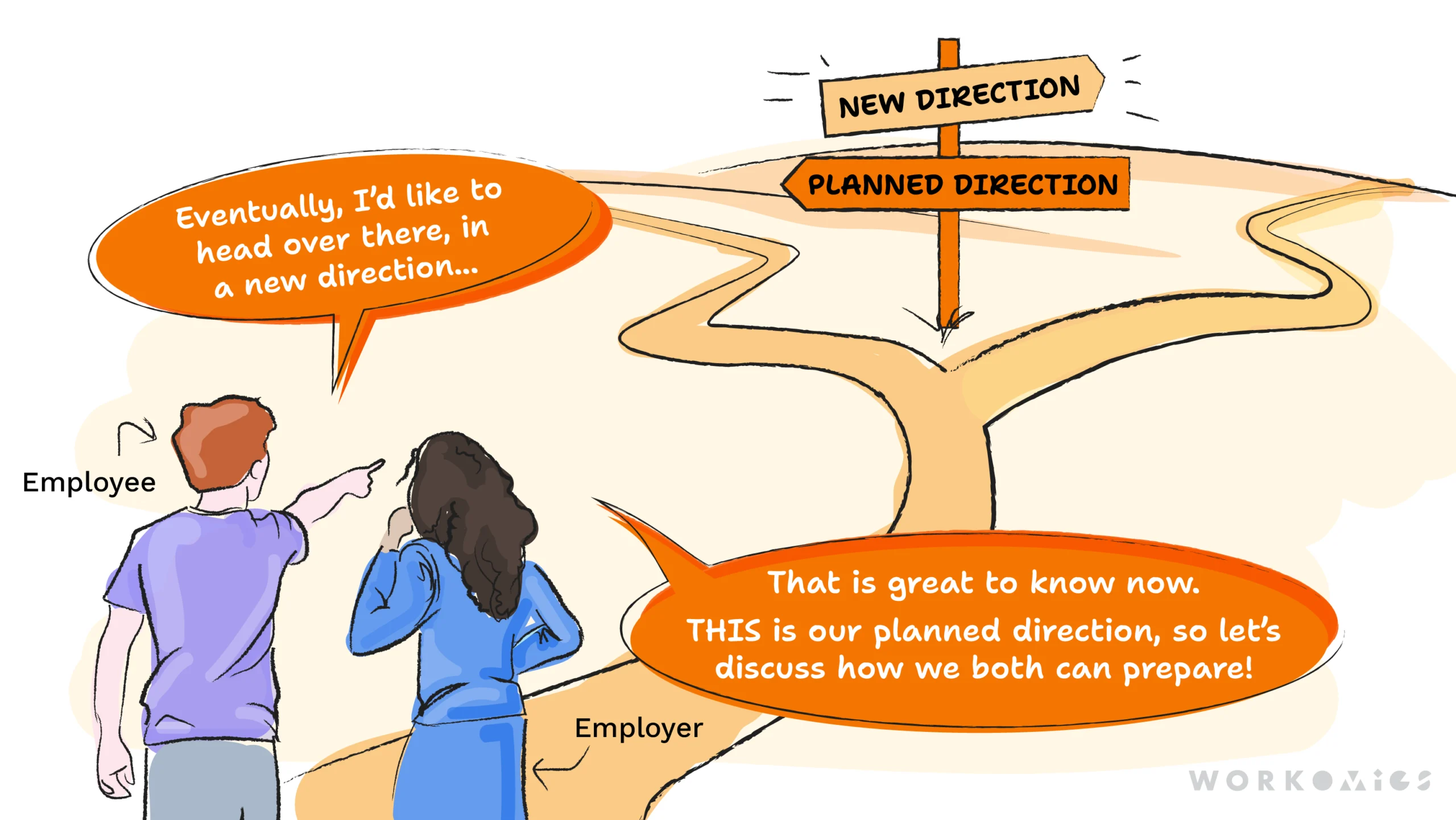
Setting new expectations for offboarding
Here is how we would love to communicate expected role tenure with new hires, right in their employment agreement.
Offboarding
While your job doesn’t have a fixed end-date, we bring employees onboard knowing they will move on to new opportunities. That might be a job in a different organization, entrepreneurship, travelling, or focusing on home responsibilities. You might choose to move on because you want to pursue a new opportunity, because of changes in your personal situation, or because the work of the company no longer fits with your career ambitions. Similarly, the company might choose to end your role because of a change in financial circumstances, or a change in direction or priorities that means we need different skills and capabilities.
We are very much looking forward to working together for a rich and rewarding few years. Right now, we are envisioning you working in this role in its current form for [x]–[y] years. But of course, no one can predict the future, and either of us might want to part ways sooner. Whenever it happens, we want your eventual offboarding to be a smooth, predictable, mutually agreed process with lots of notice on both sides.
If you are thinking about leaving your role
For your part, we want you to let us know when you are actively applying for other opportunities, or if you are approached for an opportunity that you want to give serious consideration. If we can, we’d love to help you find your next role, whether that’s making introductions, providing references, or something else. At these early stages, we aren’t asking for a firm end date, or even specifics about the opportunities you are pursuing, if you would rather not share. Our goal is to have enough advance notice so that we can plan for the future. Ideally, you keep us up-to-date through your process, so that we can accelerate (or decelerate) our contingency plans.
When you are ready to tender a formal resignation, we ask you to give us four weeks’ written notice. That longer notice period is intended to provide continuity for our business, and not to be a barrier to your pursuing new opportunities. Please don’t hesitate to discuss alternatives if the longer notice period is posing a challenge for you. Ultimately, we want to facilitate you moving into your next great adventure after a productive and satisfying stint with our team.
If we are thinking about ending or changing your role
If we decide we need to end or change your role for any reason, we equally want to provide you with ample notice so that you can plan for your personal and professional life. Our work lends itself to natural stopping points, where roles will need to end or change to meet changing client needs. Usually, those stopping points are foreseeable at least 3–4 months in advance, and we commit to having transparent conversations with you that weigh both the company’s needs and your career ambitions. Sometimes, however, business needs can change very quickly, because of unexpected developments with key clients or other external factors. In those cases, we might have to make such decisions on short notice.
In either case, we commit to giving you a combination of “working notice” (where you know your job is ending on a specific date, but continue to report to work to transition key tasks and deliverables) and “severance” (where you continue to receive your salary while not reporting to work). Under Ontario labour laws, as an employee, you are entitled to receive working notice and/or severance from any employer who ends your job. Typically, the amount of notice/severance you are entitled to depends on a number of factors, including how long you’ve been with the company, your age and experience level, and how long it might take you to find a comparable role elsewhere. We will strive to provide you with [z] months of severance, so that you have a financial cushion as you take time to seek your next role.
We would love to have language like that because it helps set the right expectations for the employment relationship. It’s clear and reciprocal, and also helps the new hire understand their rights. The only problem is it would cause any lawyer in a 10-mile radius to break into hives, because it exposes the company to too much risk in too many situations. The employer might still have informal conversations that convey the gist, but legal counsel will strenuously recommend new employees don’t get the clarity and peace of mind that comes from a written agreement that outlines what will happen in case of job loss.
None of us at Workomics are lawyers, nor do we play one on TV, but we do think this is a problem. In other types of business agreements, the norm is to go into great detail about how and under what circumstances the arrangement might end. And in fact, when there is a more equal balance of power between employee and employer, we do see explicit agreements about compensation when a job ends. When employees gain power through a union, they negotiate contracts (like this one) with clear entitlement to generous separation payments||. When employees gain power by rising to executive-level roles, they typically negotiate severance clauses, specifying very generous compensation. We just deny those protections to the powerless, who need them more.
Changing this status quo is no easy thing. Probably, the existing legal-regulatory framework needs to be completely overhauled to be more reflective of modern work. But also employers need to recalibrate how they think about severance obligations, and employees need to educate themselves on their entitlements, and/or join unions that negotiate on their behalf. But it’s a sea change that’s needed, if we want fairness and transparency in how companies employ workers.
*These numbers probably overstate tenure, as they are from 2020, i.e. before the Great Resignation
†We’re talking here about terminations without cause. Terminations for cause are thankfully rare, but would have to be handled differently.
‡The big consulting firms have a long had a 5-year up-or-out model, where associates know that many of them will be moving on within a fixed timeframe. Chief-of-staff roles increasingly come with a fixed time horizon and the expectation that the individual will move on to something else, whether inside or outside the organization.
§For instance, an employer’s standard practice might be to pay generous severance that exceeds common law entitlements (usually about a month of severance for each year of service). They will nonetheless tend to have employment agreements that limit severance to the legal minimum (in Ontario, one week for each year of service).
||There’s about 25 pages in this document covering job surplus, but on page 55 you see that employees whose jobs are eliminated are entitled to a lump sum of six months’ pay plus additional severance.
Our other ideas worth exploring

Three principles to make AI work for people and teams
Meet Daisy: An AI Case Study. Daisy is a Regional Sales Enablement Specialist for a large multinational in a heavily regulated industry. She works with sales executives in her region to help them build skills and deliver better outcomes for customers and the business.

Collaborating on Ambiguous Knowledge Work
The challenge comes with collaborating on something we call Ambiguous Knowledge Work (AKW) — the messy job of synthesizing research, finding a creative solution to a problem, or designing a new program. The ambiguity in AKW is not what we’re making (it’s usually a PowerPoint deck, let’s be real), but in figuring out how to make abstract ideas relevant and resonant.

An AI Policy-in-Progress
We use AI judiciously, so that we are minimizing the downsides and maximizing the benefit. Our use of AI should be additive, transparent, eco-conscious, and voluntary.