
In this post, we’re going to delve into what self-determination theory has taught us about motivation and rewards.
Different Types of Motivation
Let’s start at the notion of extrinsic motivation. In common parlance, that means someone is incentivizing us to do something with the promise of a reward (or a threat of punishment). By contrast, we have the concept of intrinsic motivation, for the things we do because they are inherently enjoyable.
But in self-determination theory, extrinsic vs. intrinsic motivation is not a simple dichotomy. Rather, extrinsic motivation comes in four different flavours: external, introjected, identified, and integrated.
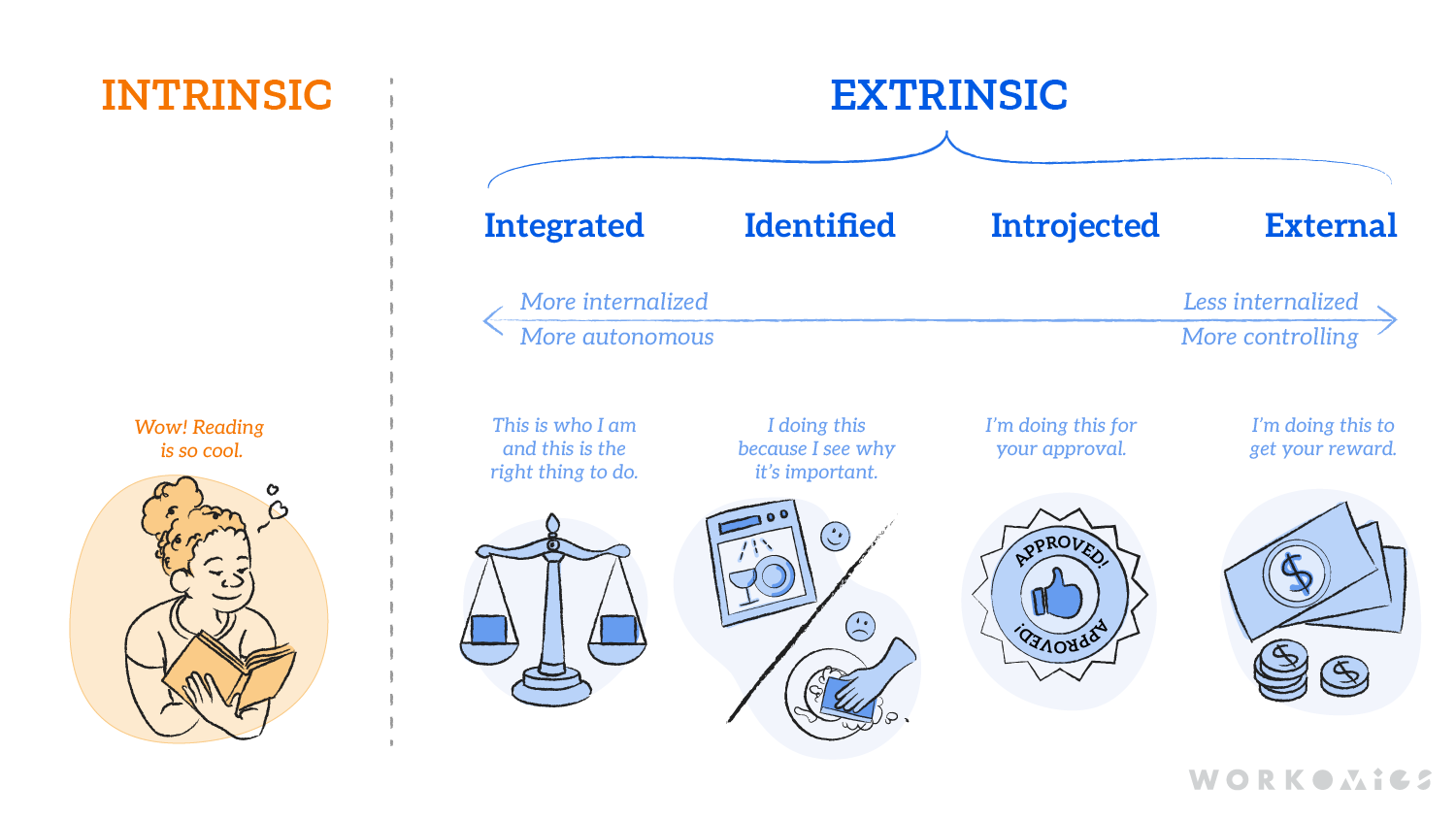
These four types of extrinsic are separate from intrinsic motivation and sit alongside it*. Most often, multiple types of motivation will be at play, and the specific words and frames we use can make one type of motivation more salient than another. For example, if someone wants their child to empty the dishwasher, they might employ any of the following:
- External: Reward them when they do (praise and thanks) and/or punish them if they don’t (take away the book they’re reading until the chore is done).
- Introjected: Ask them to do it “because I said so,” or otherwise make it clear that the parent’s approval is contingent on their dishwasher emptying.
- Identified: Help them understand why dishwashers need to be emptied regularly, so that the family have clean dishes and don’t have to wash them by hand.
- Integrated: Appeal to higher-order values like helpfulness and doing one’s fair share.
- Intrinsic: Try to make the task so inherently interesting, enjoyable, and rewarding that they find it intrinsically motivating.
It’s clear these strategies are not mutually exclusive, and we employ all of them to some degree. What’s less clear is that the different types of motivation are not strictly additive. If you talk about emptying the dishwasher in terms of helpfulness and fairness and then start paying allowance for chores, you won’t end up with a kid who is now extra motivated because there are two different incentives at play. What usually happens instead is that the more external motivation (money) crowds out the more internalized motivation (values). In the extreme, you could end up with a kid who won’t empty the dishwasher unless they are paid, because the allowance has completely undermined the more internalized motivation to be helpful and contribute their fair share.
That is not to say there is one right way to motivate. It is to say that the context of the request and the relationship really matters, and we should think carefully about our goals, the motivational strategies we’re using, and what the effects might be.
Motivation in the Workplace
When we move into the workplace, we have the same five types of motivation at our disposal, but they look a little different:
- External: Praise, feedback, and especially variable compensation to reward behaviours we want to see.
- Introjected: Making it clear that certain behaviours are basic expectations of the role, and approval of peers and bosses is contingent on doing it.
- Identified: Communications that explain why certain behaviours are necessary/helpful for the organization, in terms that employees can understand
- Integrated: Tying behaviours to mission, purpose, and values that have resonance for employees even outside of work.
- Intrinsic: Designing job roles in such a way that the desired behaviours are more likely to be inherently interesting and rewarding.
Our hypothesis is that organizations will better motivate their employees if they make conscious decisions about which type of motivation to emphasize, based on the what underlying motivation predominates, and why specific behaviours and activities are being motivated. In practice, we think this is rarely done, and organizations instead rely on force of habit. Sometimes, habit works fine — an activity like filing expense reports is an introject, and it would be weird to have it otherwise. But often, we have a choice about which type of motivation we make most salient to employees, and that choice will have a significant bearing on their subjective well-being at work.
- If logging sales calls in the CRM is framed as an introject, it will feel more like drudgery than if we help employees internalize how those notes grow our organizational knowledge base and inform marketing and growth strategy. This works best if we can actually show staff how their contributions fed into key decisions, not just tell them why it’s important†.
- In the other direction, we think companies can over-index on mission and values. Sometimes, organizations need to make choices for very quotidian reasons of cost and revenue, and if you try to message that with reference to mission and purpose, staff can’t do that integration with their personal values, and it doesn’t resonate.
However, it’s external motivation where the gap is widest between common organizational practice and what self-determination theory tells us about motivation. The conventional organizational wisdom is that people are significantly motivated by compensation, and so holding out external incentives like raises, promotions, and bonuses in exchange for performance is a way to drive better organizational results. But empirical work in self-determination theory tells us that in many cases, the opposite is true.
External incentives do work pretty well when tasks are simple and quantitative in nature (i.e., we care more about how many widgets you produce, vs. the quality of each individual widget). Empirically, we don’t see significant drop-offs in performance, as long as the external incentive remains in place‡. Where external incentives are problematic is when tasks are complex, require creativity, or results are assessed based on qualitative features. Not only is performance lower with external motivation, but employees report higher levels of stress and burn-out, do less knowledge-sharing with colleagues, and are less persistent.
Principles for autonomy-reinforcing external reward
In some sense work is definitionally an extrinsically motivated undertaking: the fact of getting paid is why we consider it work. However, that doesn’t mean the negative effects of external motivation are inevitable. The mechanism that creates these undesirable effects is control — the feeling of being controlled through rewards is what mediates lower performance, higher stress, less collaboration, less persistence.
There has been a lot of empirical work in self-determination theory to help uncover what makes people feel more controlled vs. autonomous in their motivation. Although many of these studies are in controlled laboratory environments, we nevertheless think they are instructive for the real world. If we were tasked with designing external rewards for any kind of knowledge work, here is how we would make those principles as autonomy-reinforcing as possible.
Choose base compensation whenever possible
Base compensation is what self-determination theory calls a non-contingent reward — given some minimum standard, you receive your wages just for showing up. In general, base pay is not experienced as controlling. As long as base compensation feels fair, it isn’t salient to everyday work tasks, so it fades into the background, and doesn’t shape your day-to-day motivation.
In contrast, bonuses are performance-contingent rewards that are received for performing to a certain level or delivering certain results. Bonuses are not all bad — they convey information about your competence, and feeling competent is a source of well-being and internal motivation. But bonuses are also a form of control — the employer is explicitly holding out rewards to try and induce employees to take certain actions. Bonuses may be such an expectation in certain roles that you can’t avoid them and be competitive in the labour market. But whenever it’s viable to avoid variable compensation and just have a flat salary, that would always be our first choice.
Reframe bonuses and reduce their saliency.
If you must offer variable compensation, the trick is to reduce the characteristics that make it feel controlling and demotivating. It is common in many organizations to frequently reference bonuses as a way to motivate individual behaviours and actions. The trouble is, the more often you do that, the more controlling the bonus feels to the recipient. It’s also likely counterproductive. Remember that when tasks are complex and the quality matters (which is often!), emphasizing external rewards is likely to decrease performance while also increasing stress and likelihood of burnout.
What can be more effective is to frame bonuses as profit-sharing. That framing turns variable compensation into a natural consequence. Rewards that are a natural results of an activity don’t feel controlling or demotivating. The difference is subtle — bonuses are surely also paid out of profits — but empirical evidence suggests that nuance makes a difference in maintaining more internalized modes of motivation.
Eliminate ranges in rewards
It’s fairly standard to communicate ranges for compensation (“raises will be 3-5% this year”) and be opaque on why individuals were placed at different points within the range. The trouble with ranges is that anyone who gets less than the known maximum is going to have their motivation undermined. What you’re doing is removing the positive effect on motivation that comes from competence feedback. Everyone who got 3% or 4% experiences the demotivating effects of control, and the demotivating effects of being judged less competent than others. It’s probably fine to have bonuses that vary by some very clear-cut, objective criteria (say, managers vs. directors), but otherwise, just pay everyone the same amount.
Don’t schedule feedback
Self-determination theory outlines two main aspects to feedback: informational and evaluative. To the extent that the feedback is informational, it doesn’t undermine autonomous motivation. To the extent that feedback is evaluative, it is functioning as an external reward. That means if evaluative feedback is less-than-glowing, it tends to be demotivating because it thwarts your psychological need for competence. What you ideally want to do is make any negative or constructive feedback as informational as possible, so the person receiving it feels like they’re receiving insight on how to improve, rather than being weighed, measured, and found wanting.
The trouble is that any time feedback is scheduled and expected, it’s much, much harder to make it informational. When we are expecting feedback, as in an annual review, it is the evaluative component that is most salient. If that feedback is tied to promotions and raises, it’s a double-whammy: evaluation is demotivating if it identifies any weaknesses or areas for improvement, and your more internalized forms of motivation have been undermined because you are focused on the external rewards. Keeping feedback part of everyday routines and avoiding scheduled, formal review meetings goes a lot way towards keeping feedback informational, and reinforcing internal motivation.
Foster autonomy-supportive management
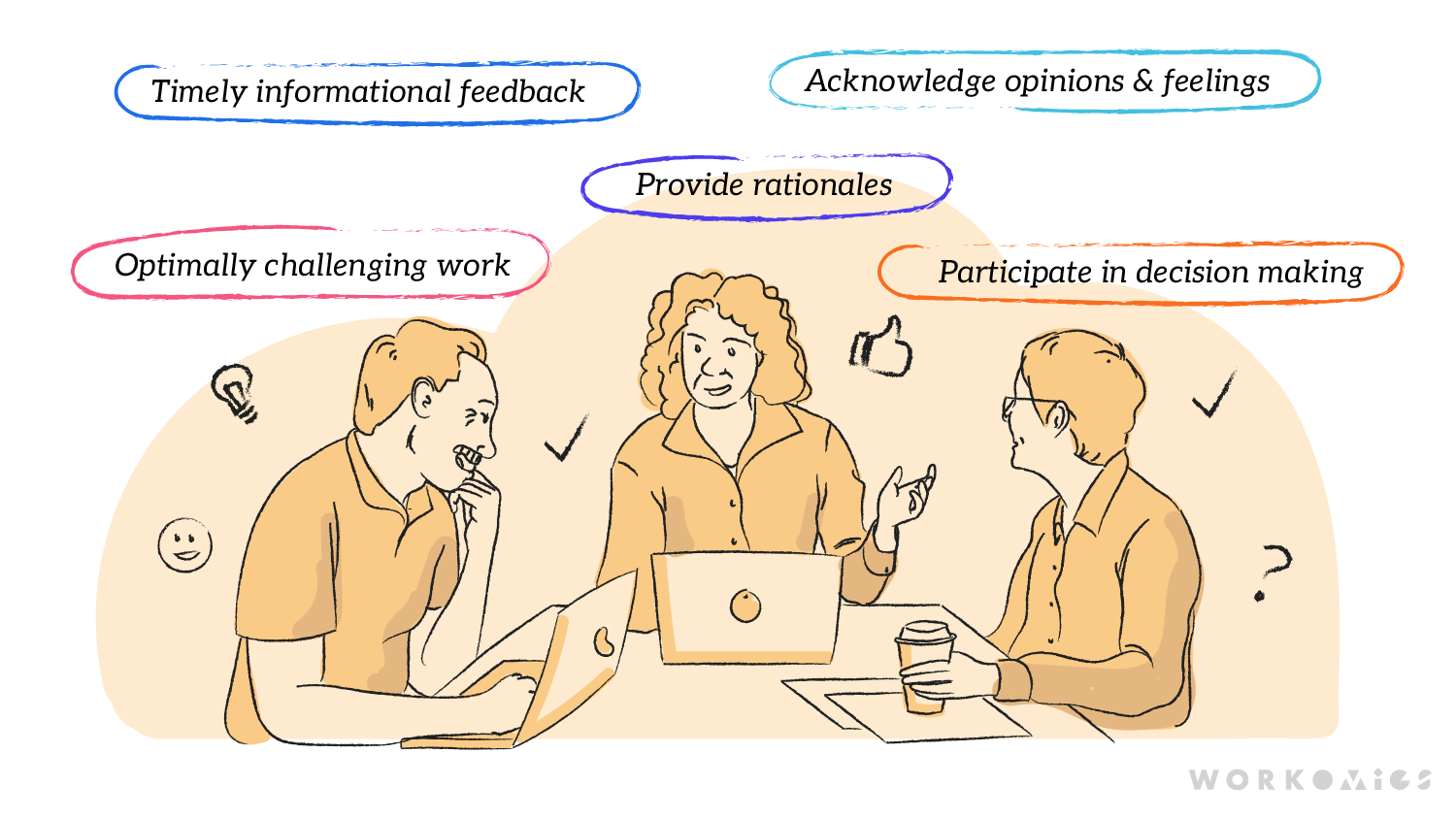
Against all those small tactical tweaks to rewards and feedback, perhaps the most meaningful step you can take is to train managers to be autonomy-supportive. Autonomy-supportive managers:
- Provide informational feedback
- Supply rationales for requests
- Make work optimally challenging
- Acknowledge people’s feelings and opinions
- Encourage choice and participative decision-making.
This is a domain where a lot of the studies have gotten out of the lab and into real workplaces, training managers to be autonomy-supportive and then measuring results on a variety of dimensions. What we see is that having an autonomy-supportive manager improves employees’ positive perceptions not just of their direct supervisor, but of upper management as a whole. Moreover, the subjective well-being of the manager providing the autonomy-support improves even more than for the direct report receiving it. But most importantly, autonomy-supportive management ‘sets the tone’ by which employees assign meaning to rewards and feedback. When a manager is autonomy-supportive, they generally get the benefit of the doubt that they are not being controlling. But if a manager relates primarily through control, that will be the default interpretation, no matter how much care you take in structuring rewards.
*There’s also a third part of the model, called amotivation, where you find no value or reward in an action, and have no intention of performing it.
†To be clear, we’re not claiming people will suddenly love CRM admin with this framing, just that it will feel like less of a slog.
‡There are, however, spillover effects. If you use external motivation narrowly for simple, quantitative tasks, you can see a negative effect in internalized motivation in more complex tasks for which you haven’t offered any external rewards.
Our other ideas worth exploring

Co-creation and Construal Level Theory: Helping stakeholders think about the details
CLT has important implications for stakeholdering and change management. Co-creation is a way to help everyone get to a lower-level construal sooner.

From Accidental to Intentional: Strategies for building better remote work relationships
There’s a very real sense in which organizations have been free-riding on the in-person bonds established prior to March 2020. But whether or not the Great Resignation is a real phenomenon, natural turnover means that many knowledge workers have a bunch of new coworkers they have never met in real life.

Mailbag: Social Change and Career Choice
In general, the more a job is focused on contributing to society and community, the less it pays. It’s not an immutable law of physics, but wages in the charitable sector consistently lag the private sector, and typically there’s a trade-off between doing good (for the world) and doing well (for yourself, financially.)