
Are you the sort of man who would put the poison into his own goblet or his enemy’s? Now, a clever man would put the poison into his own goblet, because he would know that only a great fool would reach for what he was given. I am not a great fool, so I can clearly not choose the wine in front of you. But you must have known I was not a great fool, you would have counted on it, so I can clearly not choose the wine in front of me.
~Vizzini, demonstrating dizzying recursive self-belief in The Princess Bride
Since the pandemic began, our team’s experience with virtual collaboration has been decidedly mixed. It’s fine when the output can be precisely specified in advance; where deliberate over-communication means that everything turns out as anticipated. The challenge comes with collaborating on something we call Ambiguous Knowledge Work (AKW) — the messy job of synthesizing research, finding a creative solution to a problem, or designing a new program. The ambiguity in AKW is not what we’re making (it’s usually a PowerPoint deck, let’s be real), but in figuring out how to make abstract ideas relevant and resonant. At the outset, we can’t really describe what good looks like; there are many possible good outputs, and many bad ones too. Somehow, we need to get everyone working together to build the same thing, even when we don’t know what that thing is.
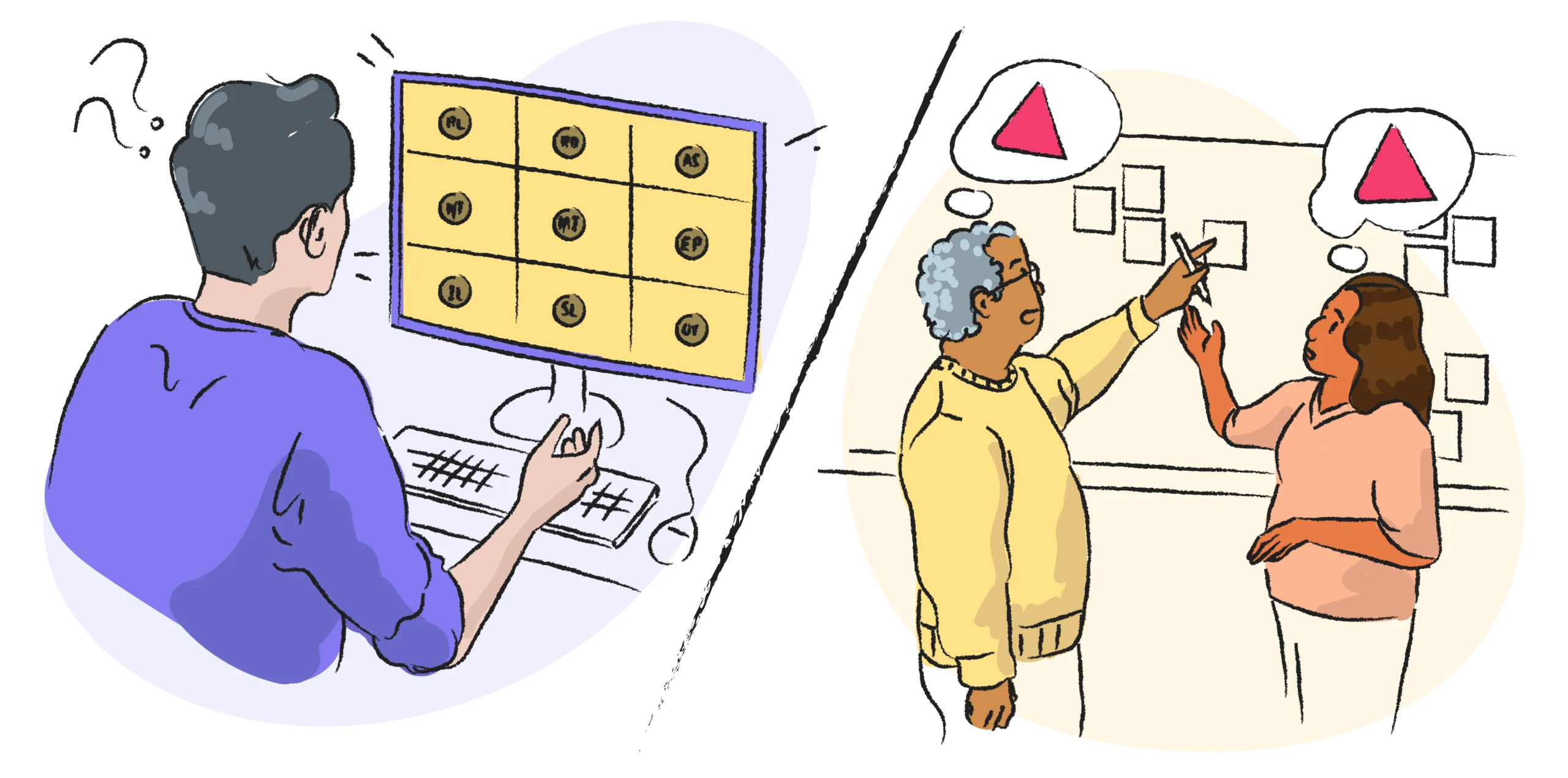
And sometimes, remote collaboration on AKW is great! We are using different tools, but the difference between remote and in-person is imperceptible. And then there are the Other Times, when AKW feels so much harder than doing the same tasks in-person. Specifically, the collaboration is what breaks down. We are ostensibly working together, but it’s not multiple people contributing ideas and building on each others’ work. Instead, it devolves into one person driving, and everyone else relegated to ‘helping.’ It’s bad for everyone: the driver is over-burdened and holding too many things in their head, while the helpers are frustrated to not be contributing to the fullest of their capabilities.
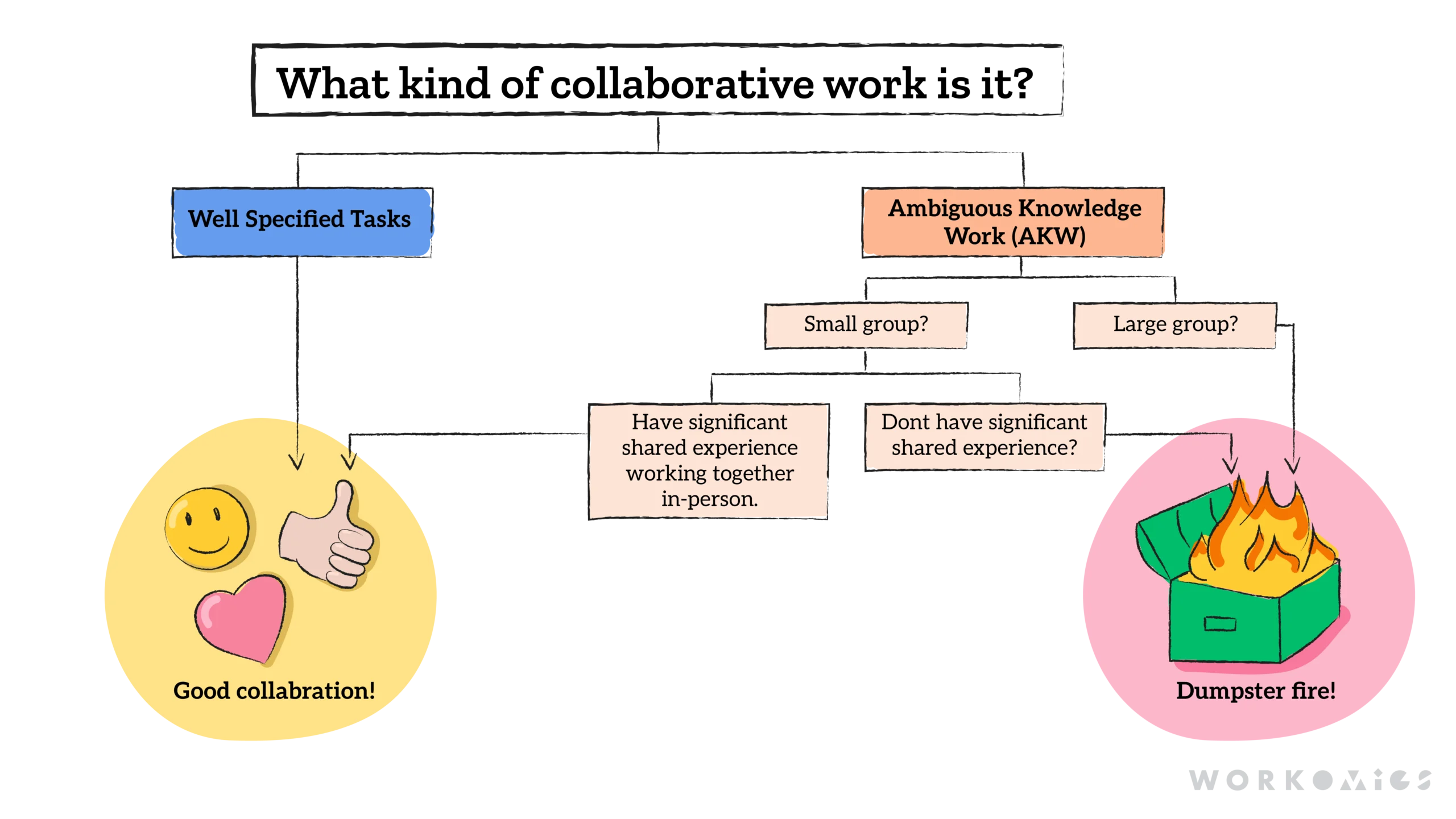
Sometimes remote collaboration works, and sometimes it’s a dumpster fire.
This observation led us to the empirical work of psychologists Felix Warneken and Michael Tomasello*, where they identified the phenomenon of shared intentions as being a distinctly human ability. Shared intention “creates a shared space of common psychological ground that enables everything from collaborative activities with shared goals to human-style cooperative communication.” Warneken and Tomasello conducted experiments with toddlers and chimpanzees, to see how they would behave on cooperative tasks and games with adults. They found that toddlers are able to form shared, cooperative intentions — they don’t just help adults, but attempt to re-engage adults even when the adults stop pursuing the goals. By contrast, chimpanzees would help adults with a more limited set of goals (for instance, reaching an object), but didn’t display any ongoing joint commitment if the adult stopped engaging. The toddlers formed shared intentions, while the chimpanzees formed individualistic intentions.
Recursive Social Belief
What’s really interesting about shared intentionality is that it requires recursive social belief†. That is, not only do I need to believe that we have the same intention, I also need to believe that you believe that we both have the same intention. Knowing what our collaborators are paying attention to is critical to getting beyond helping on someone else’s goal and actually forming a shared intention.
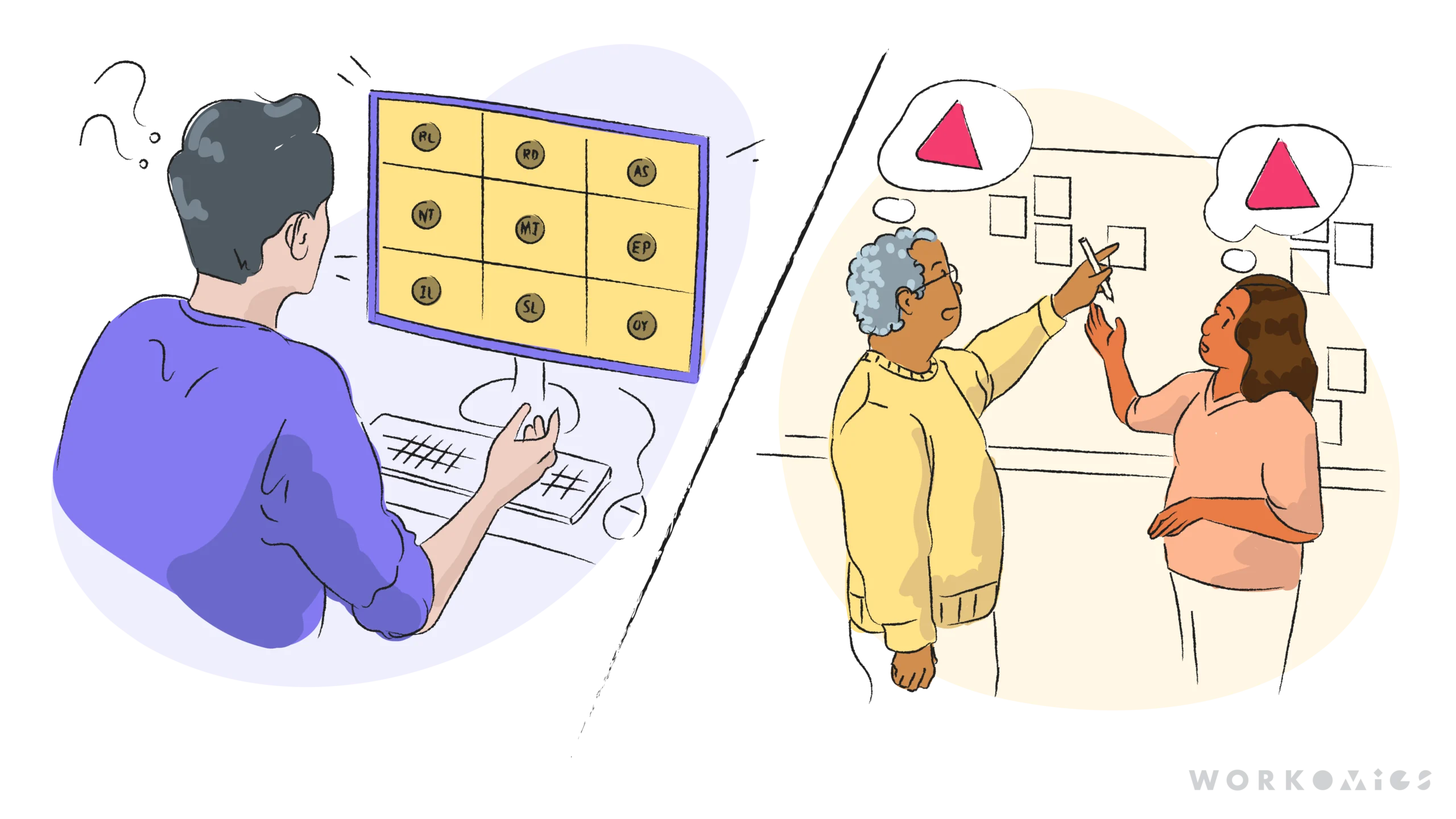
In a typical real-life collaboration on AKW, we might stand around a whiteboard as a team. We can see everything written on the whiteboard, but we can also tell where our teammates are focusing their attention (and vice versa). If switch your gaze to the other side of the board, you are conveying valuable information about your own thought processes, and you also know that I am receiving that information. That recursive knowledge of other people’s focal points is doing really important work of keeping us aligned, and keeping our intention truly shared.
Most of the academic work on shared intentions is focused on how it develops in early childhood, which is fascinating but not so helpful for adults in a work context. What was applicable is a study of shared intentions among pairs of computer programmers collaborating on AKW‡, undertaken by Josh Tenenberg, Wolff-Michael Roth, and David Socha. They found that in-person programmers are “continuously doing alignment.” Each programmer monitors his partner’s work, but also monitors his partner’s monitoring and thereby achieves recursive social belief. They also found that co-located programmers are nevertheless able to work in silence for stretches — the actions they take on the screen do the work of communication and turn-taking§.
By contrast, when pair programmers work remotely, they don’t work in silence, but rather narrate their actions. (“I’m going to copy this line over here…”). We can look at this narration as both a recognition of and compensation for the loss of recursive social belief. The problem with narration as a solution is that it’s unidirectional: the listeners know where the narrator is focusing attention, but the narrator is not receiving any information about the listeners’ attention. In fact, you could imagine the narrator getting a false sense of recursive social belief: they assume their teammates are focusing on the things they’re talking about, even when it’s not the case. That doesn’t require the listeners to be distracted or multi-tasking. They could simply be paying attention to different lines of code on the screen, and thereby forming a subtly different intention.
In the specific context of pair programming (even remotely), any lack of alignment is quickly identified and repaired, because all of the work is done synchronously on a shared screen. But for most remote collaborative AKW, we don’t sit side-by-side with a shared work product. Typically, we meet virtually to align, go our separate ways to do individual work, and then reconvene—only to discover that whoops! We weren’t as aligned as we thought. We didn’t maintain shared intentionality, and we’re back to someone driving an individual intention with teammates helping.
The Right Tools for Ambiguous Knowledge Work
One implication here is that doing AKW is a good reason choose in-person meetings over remote. You should continue to collaborate in-person until most of the ambiguity has been resolved, and you can go back to working remotely on well-specified tasks||. But if AKW must be done remotely, then we should change the default tools we use. Based on the pair programming research, our team has formulated some principles we aim to follow when collaborating virtually on AKW:
1. Name the problem, discussing the necessity of recursive social belief, and the challenge of knowing where everyone’s attention is focused, so we all know what we’re grappling with.
2. Stop using videoconferencing platforms for AKW. Video-based tools can’t create recursive social belief because you never know where other people are focusing their attention. The built-in screen-sharing functions are also unhelpful because they’re unidirectional, so you only get information about the presenter’s intention. Instead, use audio-only calls, and collaboration tools that let everyone edit simultaneously.
3. Use a collaboration tool with telepointers. The telepointers are especially important because they let you see the location of your collaborators’ cursors while you are all working in the same file. It’s an imperfect proxy for attention, but it’s a big improvement on having no indication at all.
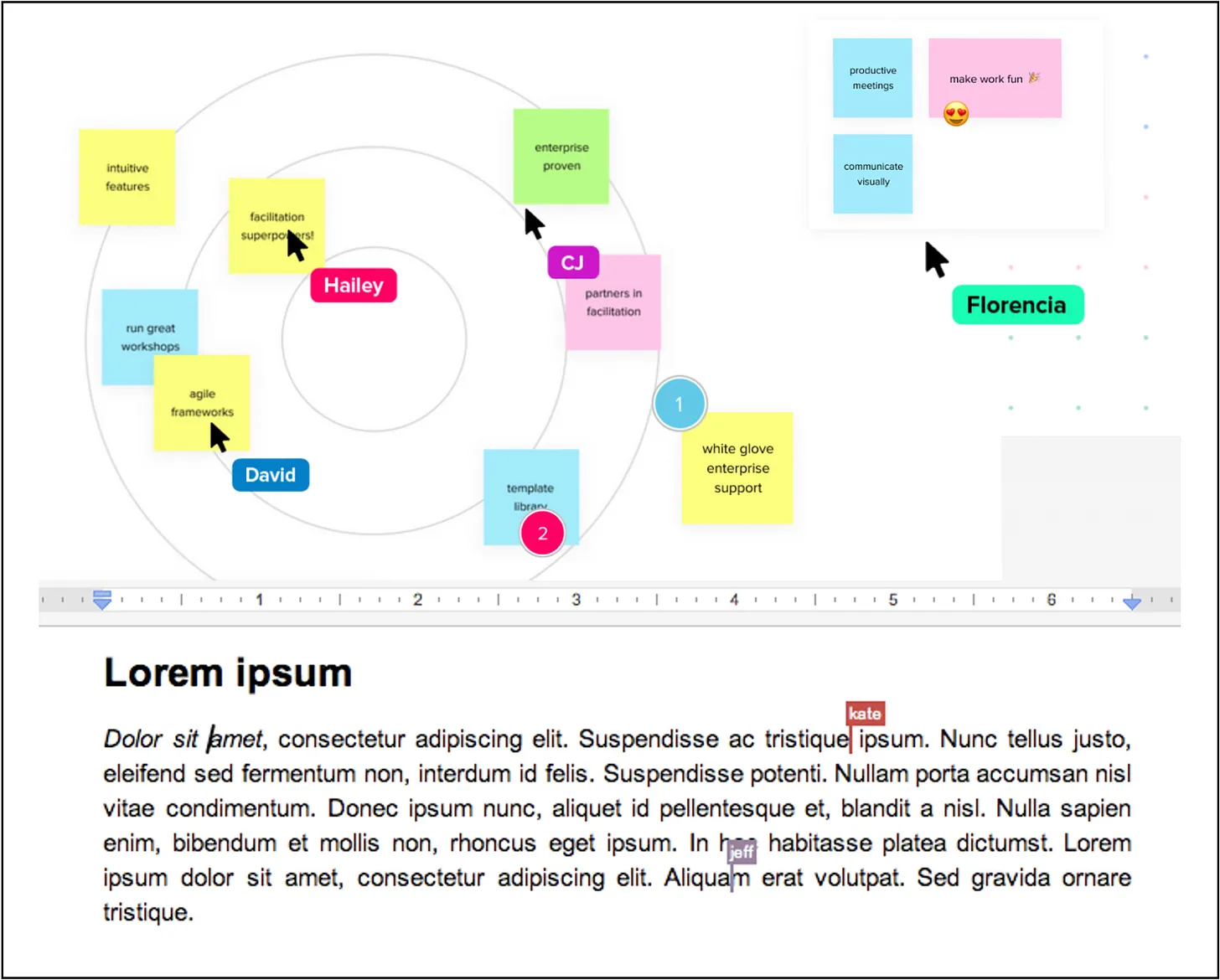
Above, a Mural whiteboard’s telepointers show us where Hailey, David, CJ, and Florencia have their cursors. Below, a Google Doc shows us where Kate and Jeff are typing.
4. Do more AKW synchronously in those collaboration tools. We’ve avoided this in the past because watching someone type is a poor spectator sport. On reflection, we were likely misguided to frame it as watching — it is turn-taking. Everyone contributes by typing their ideas in real-time, not unlike how everyone has a marker if we’re doing AKW in the same room. It’s a shift from using technology to talk about the work, to using technology to actually do the work.
5. Shorten the time between meetings, when we’re not working synchronously. Our default is typically to check in every two days or so, but that seems like an impossibly long time compared to the continuous alignment that pair programmers do. We’re therefore excited by features like Slack’s huddle, which make it easier to do continuous alignment work without formal scheduling.
6. Invest in screen real estate. One challenge our team sometimes has with online collaboration tools is that it’s hard to get the resolution right. In real life, it’s easy to stand so that you can read the whiteboard and see where others are focusing their attention. Once you move digital, if you’re zoomed out enough to see where everyone’s telepointers are, you often can’t read the text. This is especially true on a laptop screen, so we advocate for upgrading to 27” HD monitors, best bought in Black Friday sales.
Our team is continuing to see improvements in how we tackle remote AKW with benefit of these principles. If you try some of them, or have ones to add, please share!
Footnotes:
*Warneken and Tomasello have published widely on the topic, with a number of different co-authors. The three I read were: Altruistic Helping in Human Infants and Young Chimpanzee, Helping and Cooperation at 14 Months of Age, and Shared Intentionality.
†This coinage is from Tenenberg, Roth, and Socha’s paper, “From I-Awareness to We-Awareness in CSCW”
‡In pair programming, each individual has their own keyboard and mouse, but they share a single screen, so they are both working on the same document. In the Tenenberg et al., study, they conducted ethnography at a software company where different duos would pair up for tasks for about two hours at a time.
§This is called a perceptual gestalt — we are able to collaborate through actions alone, and the collaboration literally ‘goes without saying.’
||This is one reason we disavow the work-X-days-a-week approach to hybrid work. Some teams may need to spend two consecutive weeks in office while they hash out a thorny problem, and then will be more productive working remotely for the next three months while they do well-specified implementation tasks.
Our other ideas worth exploring

Three principles to make AI work for people and teams
Meet Daisy: An AI Case Study. Daisy is a Regional Sales Enablement Specialist for a large multinational in a heavily regulated industry. She works with sales executives in her region to help them build skills and deliver better outcomes for customers and the business.

An AI Policy-in-Progress
We use AI judiciously, so that we are minimizing the downsides and maximizing the benefit. Our use of AI should be additive, transparent, eco-conscious, and voluntary.
GenAI, capitalism, and human flourishing
How capitalism breaks down in the face of GenerativeAI, and why we need to find ways to optimize for human flourishing.