
There’s a trick we do at workshops sometimes, when we want to make a point about constraints and creativity.
First, ask the group to name as many fruits as they can in 30 seconds. The participants think 30 seconds is the constraint, so we get a rapidly scrawled list of apples, oranges, bananas. Maybe some intrepid soul ventures into berries.
Then, we repeat the exercise, but this time with an additional constraint: fruits that you think no one else will list. Suddenly, we have guava and yuzu, obscure Nordic berries, specific varietals of apples. Usually someone goes full botanist and advocates stridently for cucumbers, tomatoes, and bell peppers. The point is made: constraints can make us more creative.
That is the thesis of David Epstein new book, Inside the Box: How constraints make us better. Epstein weaves together compelling stories and scientific research, outlining different kinds of constraints and how they help:
- Constraints of time and place that push us to create something (anything), rather than wallow in analysis paralysis
- Constraints of norms and institutions that guide our interactions with other people and enable more productive collaboration
- Constraints of problem space, where limits we place on our solutions foreclose some possibilities and force more focused iteration and refinement.
Readers with a human-centred design background will recognize many familiar concepts cast in a new light. Problem framing, prototyping and iteration, systems thinking, universal design are all presented through the lens of constraints.
For the most part, Epstein’s book focuses on the dichotomy between constrained and unconstrained. We get lots of examples of people using constraints to achieve breakthroughs, set against cautionary tales where a lack of constraints contributed to stasis and stagnation. It builds a compelling case for the practical value of constraints.
But for those of us working inside organizations, it’s only half of the story. “My boss gives me too much freedom and resources,” is not a common complaint. We’re more likely to be saddled with a litany of counterproductive constraints — asked to list fifty fruits in five seconds, using an Etch-a-Sketch.
A taxonomy of constraints
Many constraints are helpful, and embracing them can stimulate “creativity, innovation, and collaboration,” just as the dust jacket of Inside the Box promises. But there are also unhelpful constraints, or constraints that might be helpful in isolation but become burdensome when layered with too many others.
Constraints live along a continuum. On one end, we have problems that are too open-ended. On the other end, we have problems that are overconstrained. Both can be equally problematic — the main risk is that you will produce nothing useful. With too few constraints, that might mean producing nothing at all; with too many, you are likely to produce something, but it may not actually solve a problem or deliver value.
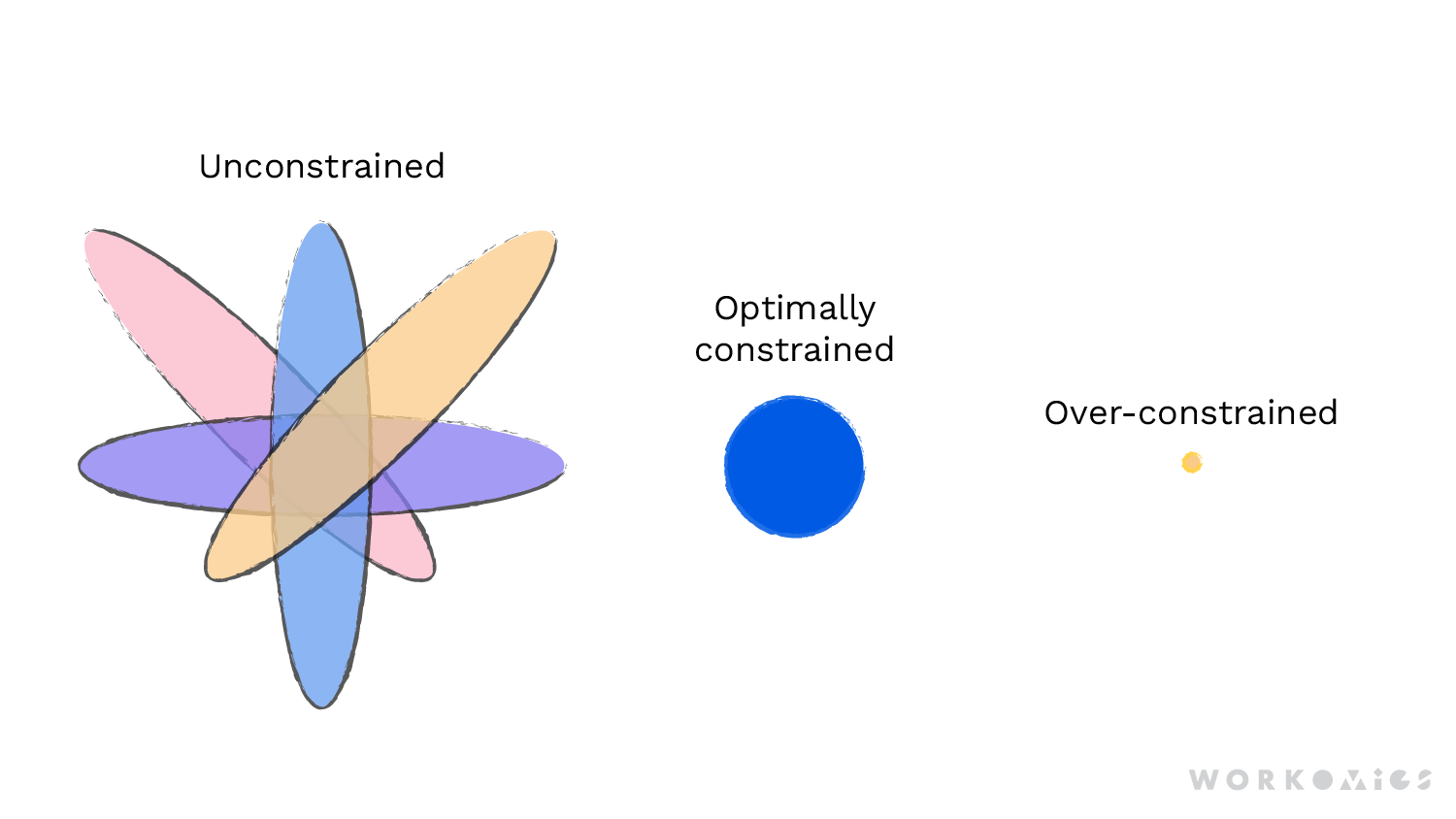
When you are optimally constrained, you retain meaningful optionality. The constraints are providing helpful boundaries, but not foreclosing too many possibilities. There is a Goldilocks principle at work, where constraints are balanced with flexibility across a number of dimensions:
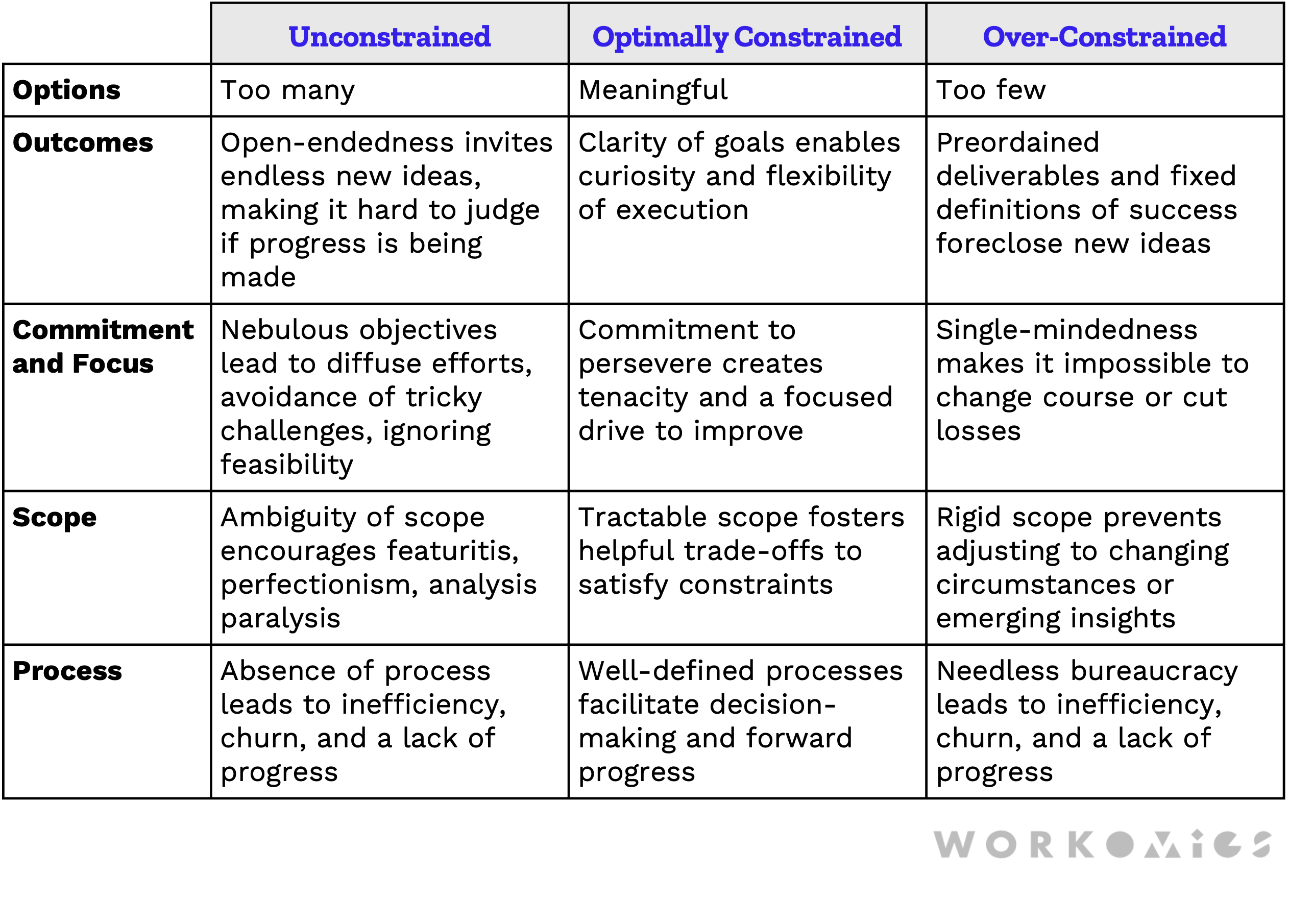
Admittedly, this is not a secret decoder key that automatically differentiates good constraints from bad ones. Crafting good, productive constraints is an art that requires judgement and practice. The task is all the harder because some of the most useful constraints are entirely arbitrary, and even self-imposed.
Navigating arbitrary constraints
There is no particular reason why a newsletter must be sent once a month (ahem), but creating that self-imposed, artificial constraint can generate motivation and focus where it might otherwise wane (ahem). In an organizational context, “because I promised the boss/the client” is often doing the same job.
However, the constraint in such cases is really just a proxy for one or more important goals. This kind of arbitrary constraint helps to crystallize the goal and make it more actionable. To judge the value of such a constraint, you have to be crystal clear on what it is helping you achieve, and the trade-offs required to meet it.
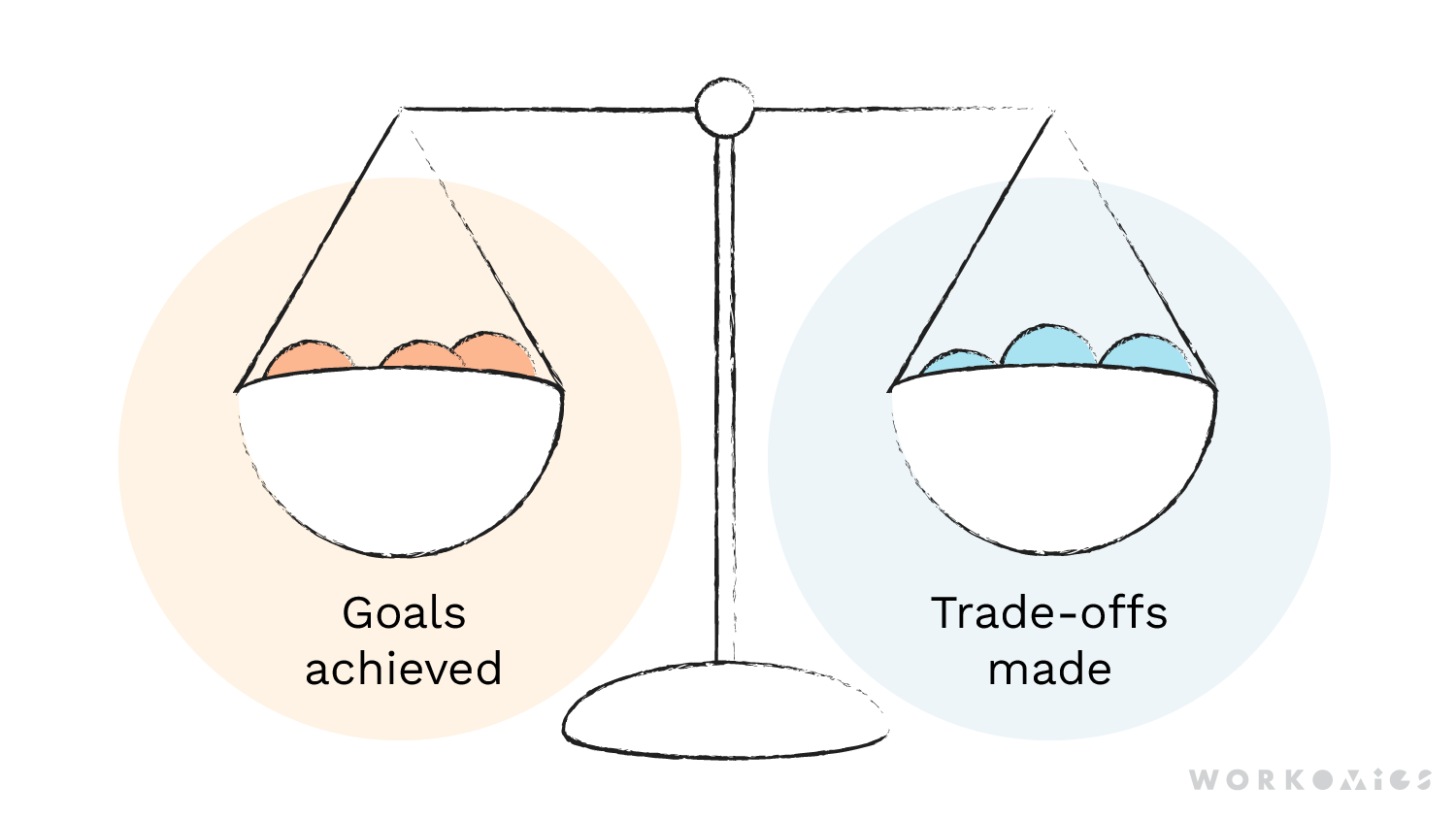
In one case, we delivered a project with a very aggressive timeline constraint that was seemingly arbitrary — our client had promised a certain date to senior leadership. There was nothing driving that particular date, but it was a stand-in for meaningful goals like speed-to-market and establishing the value of a new approach. We certainly had to make compromises to meet the deadline, but the time constraints enabled ruthless prioritization. We got to market sooner with the most important elements and gathered the data to build a case for subsequent investment. If we had been slower, we might not have launched anything at all.
But it could equally be the case that an aggressive timeline isn’t in service of a worthwhile goal, or results in unacceptable trade-offs. It is only by weighing the value of the goals implied by a constraint against the costs to satisfy the constraint, that you can begin to assess whether the constraint is a help or a hindrance.
The balance between goals and trade-offs is not fixed over time. Within an organization, stakeholders come and go. Priorities shift. New implications and trade-offs are uncovered. You should be beholden to constraints — that’s what makes them effective. However, when they are the kind of arbitrary constraint you could relax, you must also constantly interrogate them: What goals are they serving? For whom? What specifically are we giving up to satisfy them? Is that trade-off still worth it? When that balance shifts such that the constraint stops serving a goal, you are probably over-constrained.
Constraint anti-patterns
When constraints are more externally imposed, the question of goals and trade-offs becomes less relevant. However, there are a couple of traps, or anti-patterns that it’s easy to fall into when constraints are more fixed.
Constraints qua Barriers
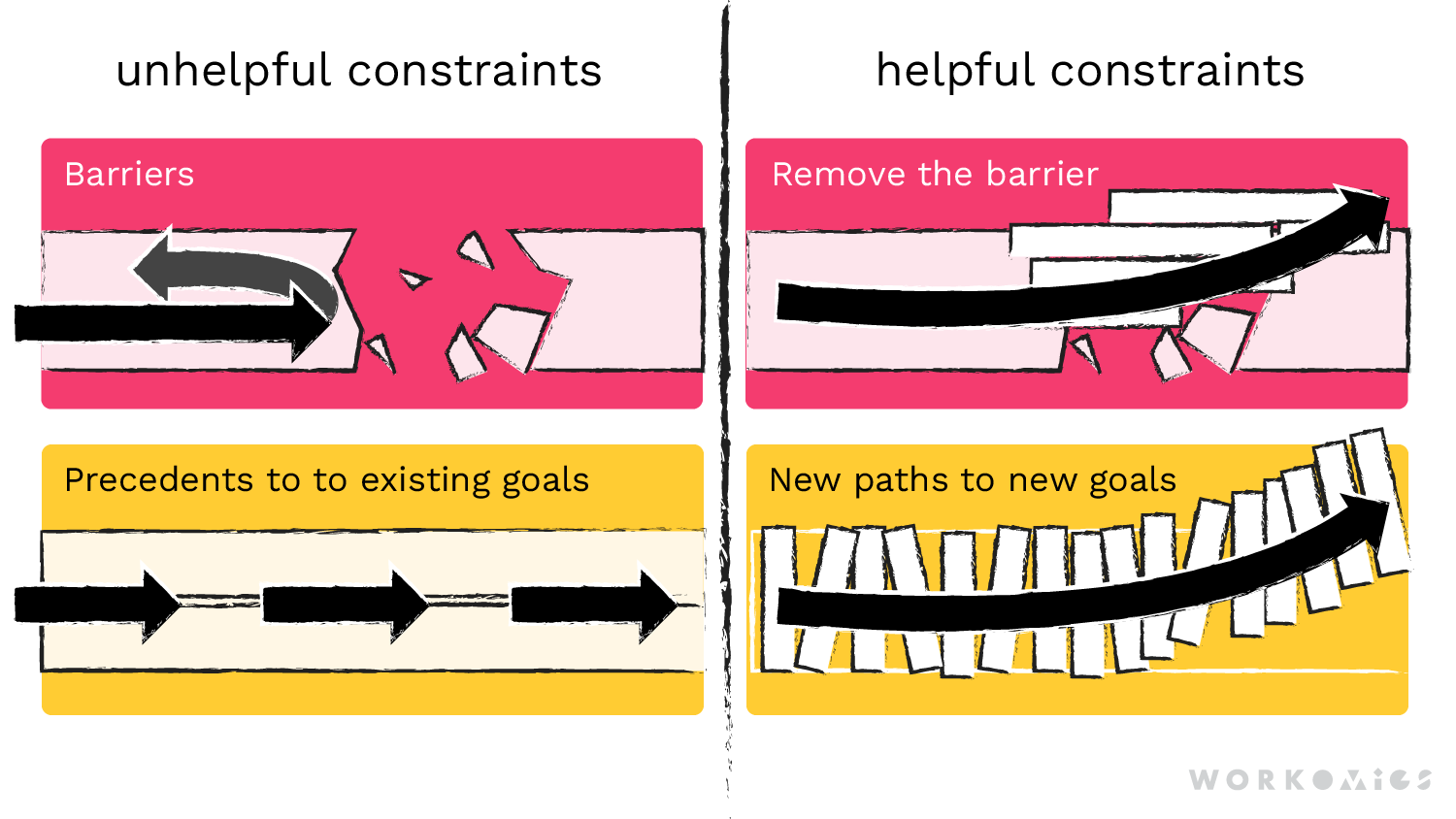
It’s rare to encounter a constraint that is utterly fixed, in a defy-the-rules-of-physics way. But many constraints feel like they can’t be shifted without breaking the law of gravity: things like lack of money, inadequate technology, or legal and regulatory hurdles. Often, it makes sense to embrace these constraints and use them as creative fuel.
But sometimes, the constraint is actually a barrier — a counterproductive obstacle that makes meaningful progress impossible. In those cases, it might make sense to change course and focus on removing the constraint-barrier. It’s not necessarily easy, but it’s usually possible to find more funding, switch focus to the underlying technological limitation, lobby for a change to the rules. If removing the barrier is not realistic (for you, for now), then it’s often better to cut your losses and apply the organization’s resources to a different problem that is more optimally constrained.
Constraints qua Precedents
Precedents are the sneakiest kind of constraint. You don’t even realize you are limiting your options, but here you are nevertheless tacitly constrained to “how we’ve always done it,” or how “everyone else” does it. Sometimes that’s fine — no need to re-invent the wheel. Other times you find yourself following a well-worn path that isn’t taking you where you need to go.
If you find yourself stuck in this trap, the solve is to turn the constraint on its head: only allow solutions that avoid the precedent. Even as a thought experiment, it can help you see new possibilities when a constraint-precedent is keeping you stuck in old patterns.
Constraints — good ones — are a positive force. The trouble is that within a corporate context, you’re just as likely to run into bad constraints, or excessive ones, or barriers and precedents marauding as constraints. Identifying constraints, the goals they are serving, and the trade-offs they are forcing will go a long way to making constraints a helpful, productive contributor to your work.
Our other ideas worth exploring

Mailbag: social change and career choice
An examination of practical ways to evaluate social impact opportunities without sacrificing your career stability.

Three principles to make AI work for people and teams
Our thinking of how to implement AI in the workplace in a way that elevates employee well-being, workflow, and team collaboration.

An AI policy-in-progress
A breakdown of Workomics’ AI policy, and how it attempts to make AI additive, transparent, eco-conscious, and voluntary.