
At Workomics, we love to learn from clinicians and how they approach patient communication.
In this interview, we spoke with Dr. Karissa Young, a pediatrician who offers general care for those under 18, about how she approaches patient communication and education for children and their families.
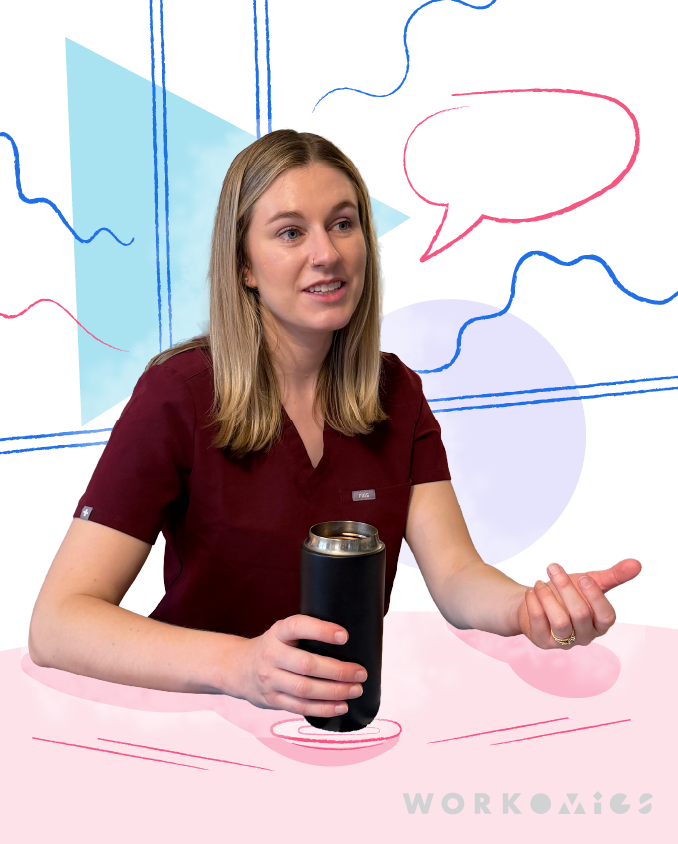
WORKOMICS (WKO): Can you tell us a little about your role as an HCP, and what a typical interaction with a patient looks like?
Dr. Karissa Young: I work at community hospitals and an outpatient clinic. In the hospital, my role involves assessing and stabilizing children in the emergency department or after birth, as well as caring for admitted patients on both the ward and in the neonatal intensive care unit. It can be fast paced and involves balancing many different priorities. In the clinic, I follow patients and their families longitudinally. I assess and manage a variety of cases, including medical, developmental, behavioural, and psychiatric conditions.
WKO: What type of information do you usually find yourself explaining to patients?
KY: I need to convey a wide range of information, including diagnoses, the results of investigations, and treatment options. This also involves working to understand patients’ and families’ preferences to determine what an appropriate treatment plan might look like. In general pediatrics, many treatments are non-pharmacological and require patients and families to change behaviours — which is challenging. I need to explain why a change is needed and provide strategies for successfully making the change.
Pediatrics also has the added challenge of having both child/teen patients and adult caregivers. As a result, I try my best to communicate in a way that is easier to understand for the patient and sometimes supplement with higher level discussion for the caregivers.
WKO: What tools do you use or find useful when trying to educate patients?
KY: The majority of education is done through conversations with families, but I’m always looking for resources, usually online, that can supplement conversations in the clinic. Families are busy, so I try to provide concise resources that I review to ensure they’re accurate and in-line with the recommended treatment approach.
WKO: How do you go about explaining complex information to your patients?
KY: I try to break information into discrete parts and relate complex concepts to other topics that the family may be more familiar with. If I’m having difficulty, I lean on online resources or talk to colleagues to review alternate strategies.
WKO: How do you know if a patient has understood what you explained to them?
KY: I pay attention to non-verbal cues and make sure to allow for time for questions. I also ask questions to try to determine their understanding. In the clinic, since I follow patients longitudinally, I’m able to assess their understanding through follow up conversations and asking how they’ve followed specific treatment recommendations.
WKO: How do you counter misinformation without alienating a patient?
KY: I try to come into these situations with curiosity — I want to know what the family thinks and why. If something is amiss, I provide accurate sources and point out why I might disagree with their perspective. I also think that building trust and strong relationships with families is one of the best ways to counter misinformation. I try not to put pressure on families to immediately agree with the information I am providing, and instead work with them over time to understand the current scientific understanding.
WKO: How do you communicate with patients and parents when you’re uncertain about the diagnosis and suspect a rare / complex disease?
KY: As a general pediatrician, I frequently encounter undifferentiated concerns — that is to say, non-specific and undiagnosed symptoms that can be minor, or serious. It can be hard to balance communicating uncertainty while maintaining the patient’s trust. I try to be honest with families about uncertainty. Many conditions, even if they are not rare, do not have a test that can provide an answer with 100% accuracy. So, I reinforce that a holistic treatment plan involves an ongoing review of the diagnosis throughout treatment and the follow-up process.
I also review with families that medicine is a team sport, and sometimes it involves multiple physicians and allied health providers, as well as the expertise of the families’ themselves, as they are the expert in their child.
Our other ideas worth exploring
Prioritizing Patient Messaging: A framework centred in patient experience
We use a patient-centric framework to help prioritize the focus of patient messaging across three phases: activate, evaluate, and initiate.

AI search is transforming patient marketing
AI search is transforming digital patient marketing. We outline how biotech marketers can create content that is more likely to show up in AI overviews.

Bedside Manners: How an OBGYN approaches patient education
An interview with Dr. Hava Starkman, a clinical fellow in midlife women’s health, about how she approaches patient education.