
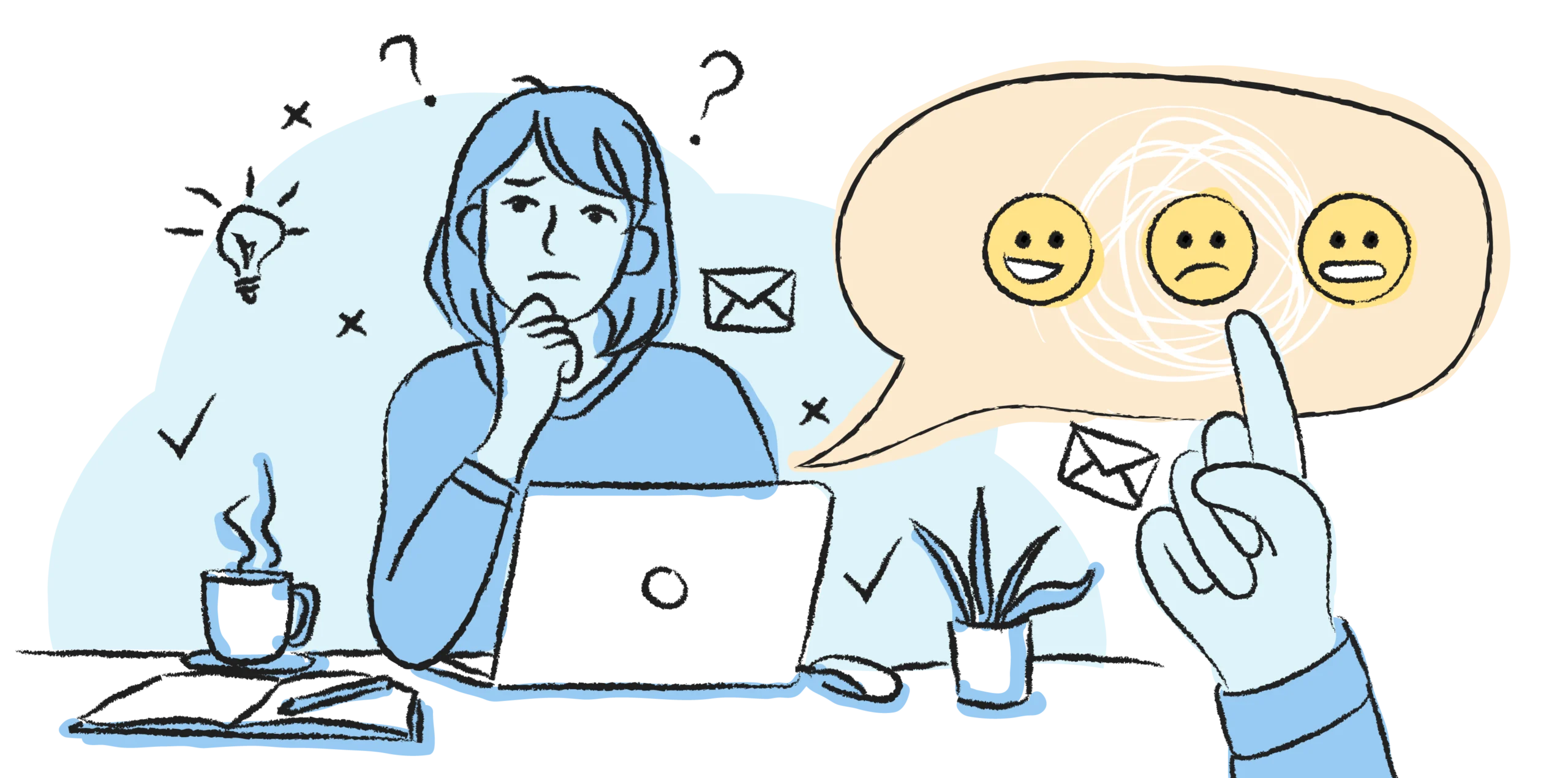
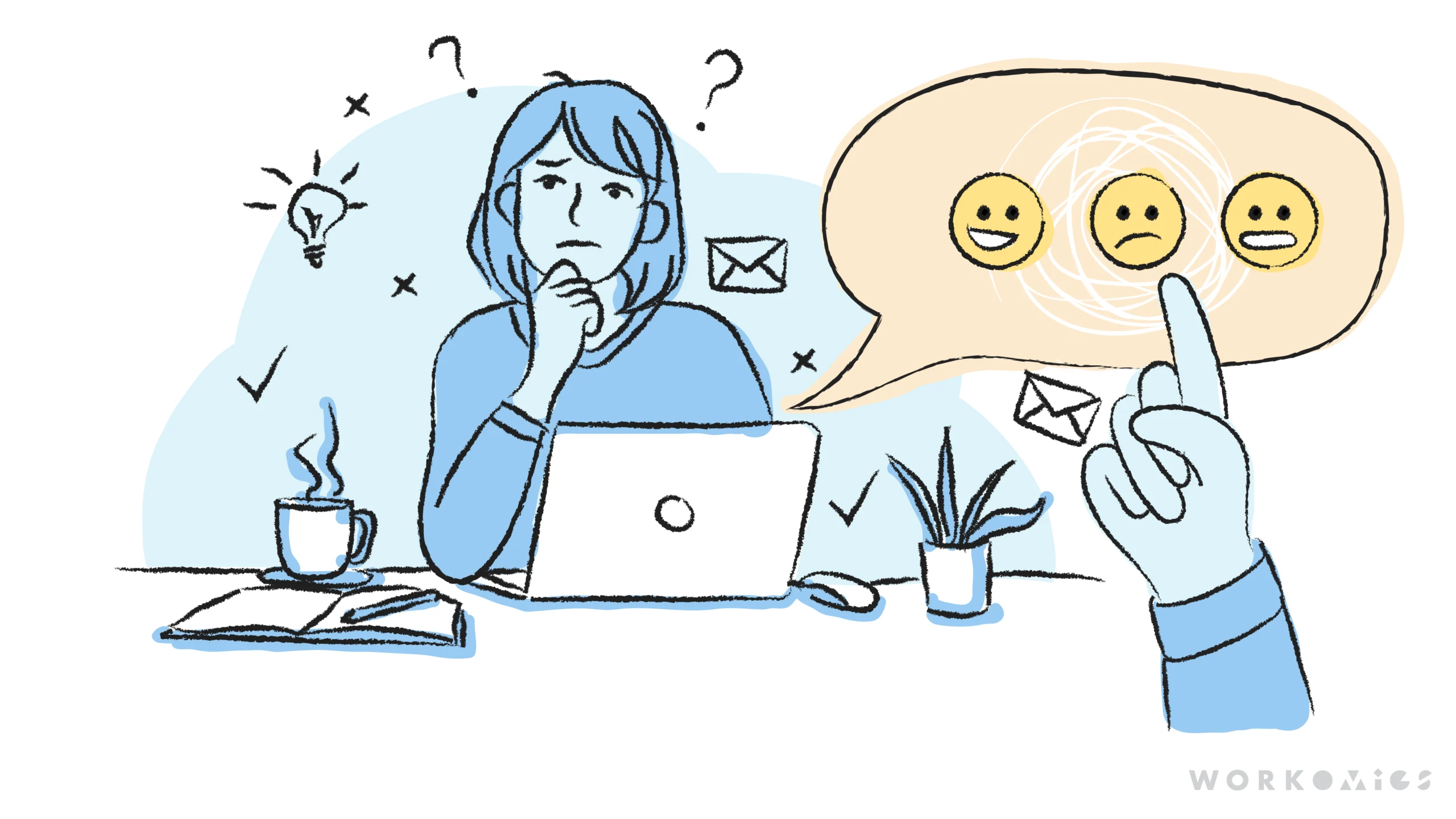
At Workomics, we often discuss the areas where working together, in-person, makes a real difference. For certain interactions – delivering constructive feedback for instance – the virtual environment can be especially “sticky” and prone to misinterpretation. Understanding why this happens is the first step toward building a more resilient remote culture.
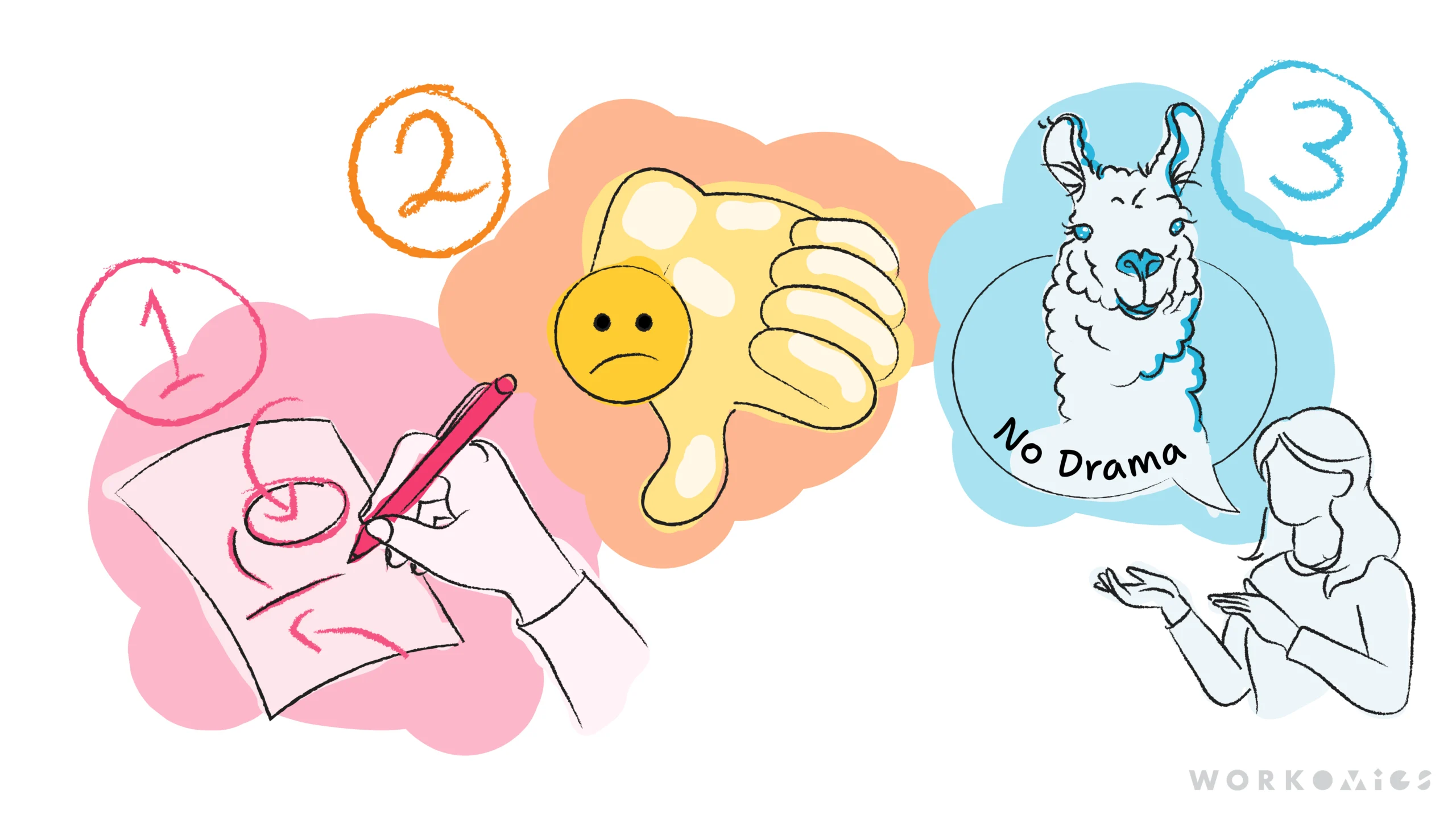
Three types of feedback
While you won’t find this framework in a traditional textbook, our team categorizes constructive feedback into three distinct types to help leaders and organizations communicate more effectively:
1. Substantive feedback on the work:
This is the kind of feedback that gets delivered via track changes or handwritten comments on a specific document. It sounds like, “let’s revise this slide to better highlight the metrics,” or “I’d like to see you rework the intro so that it better sets up the key findings in section 2.” When everyone understands this feedback as coming from a shared goal to produce the best work possible, it doesn’t feel personal. There is no subtext that someone fell short or made a mistake, so it is straightforward* to deliver, whether in-person or virtually.
2. Consequential feedback on unacceptable behaviours:
This is the kind of feedback you deliver when someone has done something entirely inappropriate, which requires censure and often HR paperwork. It is always hard to deliver, not just because the consequences are serious, but because the behaviour itself problematic enough to impugn a person’s character. This kind of feedback is thankfully rare. We haven’t had many occasions to delve into this type of conversation, however we suspect that this kind of feedback might actually be better delivered virtually. The person delivering the feedback can more easily refer to notes to deliver a clearer message; the person receiving the feedback has a bit more emotional space to process.
3. ‘No-drama’ feedback on minor aberrations:
This is feedback where we believe there is the most potential for things to go sideways remotely. By ‘minor aberrations,’ we mean venial sins like not getting your expense reports filed on time, not doing the pre-work for an important meeting, or letting your bad mood get the better of you. By ‘no-drama,’ we mean the goal is to reinforce the organization’s expectations, but do it in a way that doesn’t make a big deal about this one oversight. Whether remote or in-person, we think it’s the feedback that is the hardest to deliver consistently, and the kind that is most important for the broader organizational culture.
Why is no-drama feedback hard and important?
No drama feedback is more emotionally charged than substantive feedback on the work, because it entails falling short of a clear expectation, which might also imply a lapse in judgement†. Because it’s a bit more fraught, there’s a strong tendency to let the minor aberrations slide. By definition, we’re talking about small oversights that aren’t really a problem if they happen occasionally and/or for good reason. One late expense report, one missed assignment, one bad day — these things happen, and we all deserve some grace.
On the other hand, any one aberration could be the start of a pattern. If your no-drama feedback can prevent that pattern from forming, that’s so much better than waiting until the bad habits are established. One late expense report is no big deal, but 6 months of missing reports starts to cause real issues. But once you’ve left a minor aberration to fester, it stops being minor and you can no longer give no-drama feedback. You’ve reached a tipping point where your options are either to permanently lower expectations, or to deliver consequential feedback for (a pattern of) unacceptable behaviour.
And this is why no-drama feedback is so important within an organizational culture. When managers deliver it consistently and well, performance standards stay high and HR-related churn stays low‡. Arguably, no-drama feedback is even more important when we’re working remotely. Because it’s harder to infer behavioural expectations without the benefit of being in-person, we’re much more reliant on explicit communication of expectations, both proactively, and in the feedback we get when we fall short.
What does good no-drama feedback look like?
The ideal scenario for no-drama feedback is a quick sidebar at the earliest opportunity. In an office setting, you can usually manage this by making eye contact as a meeting is wrapping up, by walking out of the room together, or by swinging by their desk.
A great approach is to try to open up with an observation and a question to gather more context. (“I noticed you didn’t submit your thing by the deadline. What’s up?”) Often that results in the person giving themselves the feedback. (“I completely dropped the ball on that because I was so pre-occupied with X. I should have given you a heads-up.”)
One you have the context, you’re well-positioned to reinforce the clear expectation for future (“Missing the deadline is not ideal, but if there’s no other way, please give me a heads-up”), and the fact that it’s no big deal it happened this time (“I understand X put you in a difficult position”).
The goal is for the person to leave the interaction with the behavioural expectation reinforced, but feeling supported and not shamed. And the whole thing takes less than five minutes.
The challenges of remote no-drama feedback
Unfortunately, so many of the elements of good no-drama feedback break down in a remote setting. It’s much easier to just let it slide and not give the feedback in the first place; and if you do go ahead and give the feedback, it’s much harder to keep the drama out:
- Setting: In person, it’s easy to casually start a conversation, asking questions that deliver the no-drama feedback such that it hardly feels like feedback at all. Phone or video calls are the closest analogue to face-to-face, but in a lot of environments, they don’t feel casual — in many places, phone/video calls are exclusively things that are scheduled and calendared in advance. For no-drama feedback, scheduling a call (sometimes days later) feels instinctively wrong. It’s imbuing the situation with too much import, and potentially delaying the conversation to the point where it feels well, dramatic, to dredge it back up.
- Subtext: When communicating in writing, you lose the ability to use tone and body language to underscore the no-drama aspect of the feedback. People read in lots of different subtext to the written word, and you can quickly find yourself in a situation where you’ve created lots of drama when you were aiming for none. And good luck drafting that email in the same five minutes it would have taken you to have the conversation.
- Synchronicity: Remote work and back-to-back calendars make it hard to find time for a synchronous conversation. But if feedback is a one-way communication (i.e. sending out a message rather than having a back-and-forth conversation), you’ll be tempted to skip the context-gathering step — opening with a question prolongs the uncomfortable feeling of being in the middle of giving feedback. But most people are working hard, striving to do well, and contributing in meaningful ways, and you want to give feedback that acknowledges this context. Ultimately, feedback can only be truly ‘no-drama’ if the person receiving it feels seen, supported, and valued for their specific contributions.
Making no-drama feedback easier
Bad things happen if we skip no-drama feedback, especially in a remote or hybrid environment. But we don’t think remote no-drama feedback is an intractable problem, if you can establish some cultural norms to support it:
- Create a culture where it’s normal to say, “can I call you for a quick second” to deliver no-drama feedback. This works especially well if you can also be in the habit of making those calls to convey messages like, “I just have to tell you that was really awesome. So good on [specifics].”
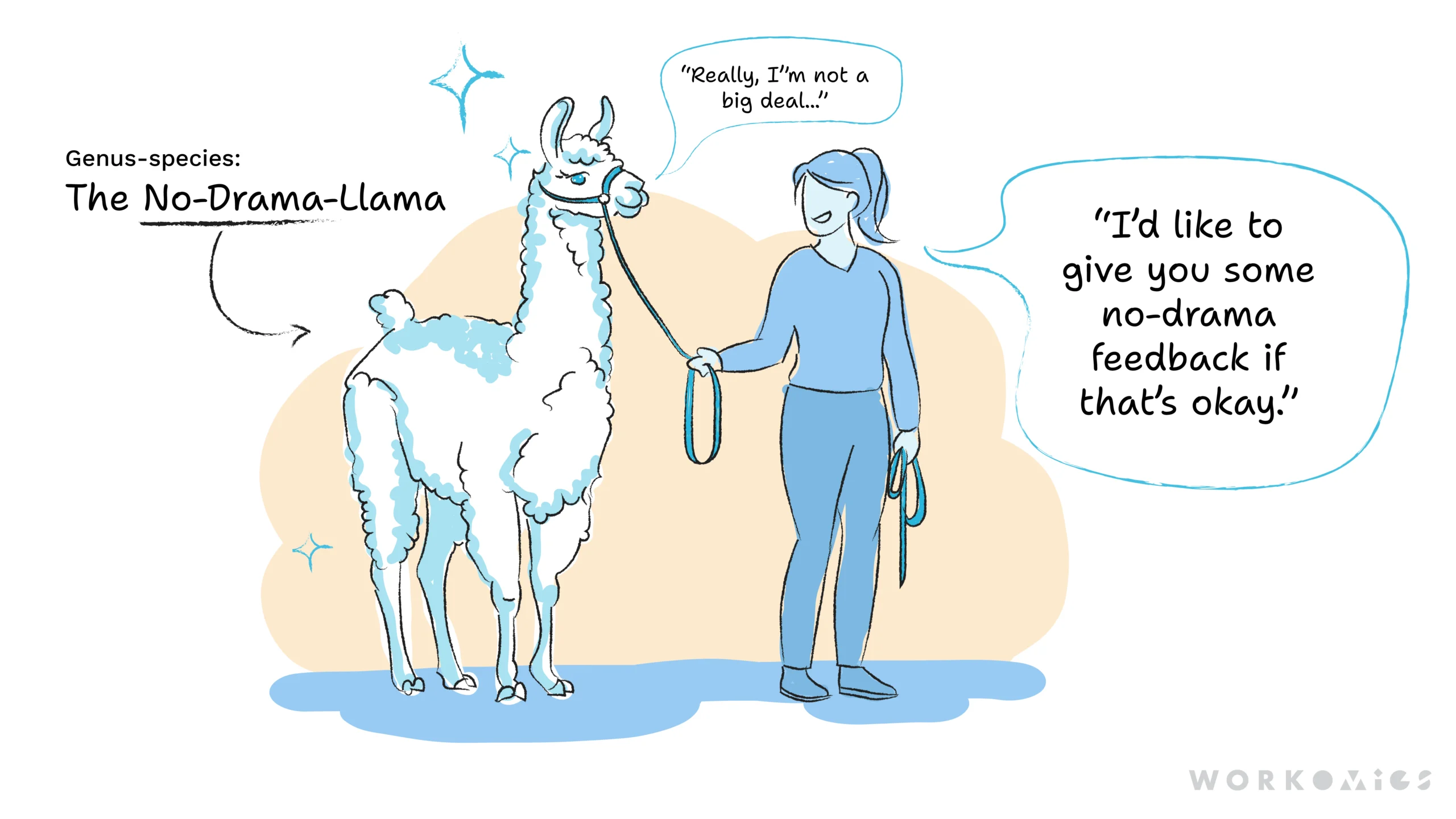
- Name it. “No-drama feedback” is just my term for it, but come up with a moniker you like and make it part of your organization’s vernacular. Then use that name in your set-up, so everyone knows what the goal is. (“I’d like to give you some no-drama feedback if that’s okay.”). It doesn’t make the problem of unintended subtext go away entirely, but it helps keep people on the right ladder of inference.
- When working remotely, make it okay to sacrifice timeliness to keep subtext and synchronicity. The gold standard is to deliver feedback as in-the-moment if possible. But you can make it a cultural norm to raise feedback after a delay, without it carrying any special import. Having a name also helps remind someone that even though you’re bringing up something from a few days ago, it’s still no-drama.
- One defining feature of no-drama feedback situations is that they cease to be an issue if you’re proactive in communicating about them. If a colleague gives a heads-up about their late expenses, they’re communicating “I know this is the expectation, but I’m exercising judgement in the face of competing priorities.” When we do that, our bosses aren’t left wondering whether we understand the expectations, and they also have the opportunity to provide additional context that might change how we prioritize things. When we make this level of accountability and proactive communication part of our behavioural expectations, there’s much less need to deliver no-drama feedback in the first place.
* Straightforward does not mean easy! But rather, it is much less likely to be fraught with an emotional component.
† As often as not, it’s a case of multiple competing priorities, and it was actually a reasonable judgment call to drop that particular ball. But the subtext of ‘I’m not sure you made the right call,’ is there either way.
‡ That is to say, a culture with consistent no-drama feedback doesn’t just mean there is no drama associated with a particular piece of feedback, but that the overall levels of drama in the organization are significantly lower.
Our other ideas worth exploring
Calibrating constraints
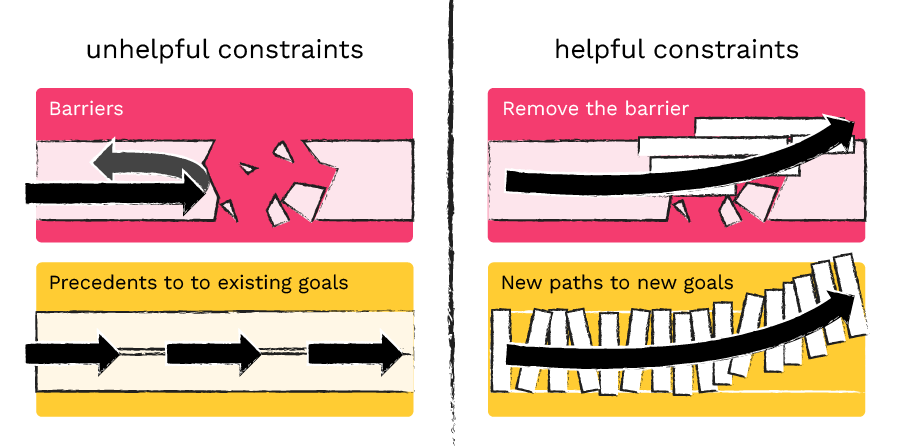
A discussion about the nature of constraints at work, focusing on their benefits and drawbacks, and tips for working within their bounds.

Co-creation and the ownership effect
An examination of the challenges of balancing paid work with caregiving responsibilities, with suggestions for how to create a caregiver-friendly workplace.
Caregiver-friendly workplaces
An examination of the challenges of balancing paid work with caregiving responsibilities, with suggestions for how to create a caregiver-friendly workplace.