
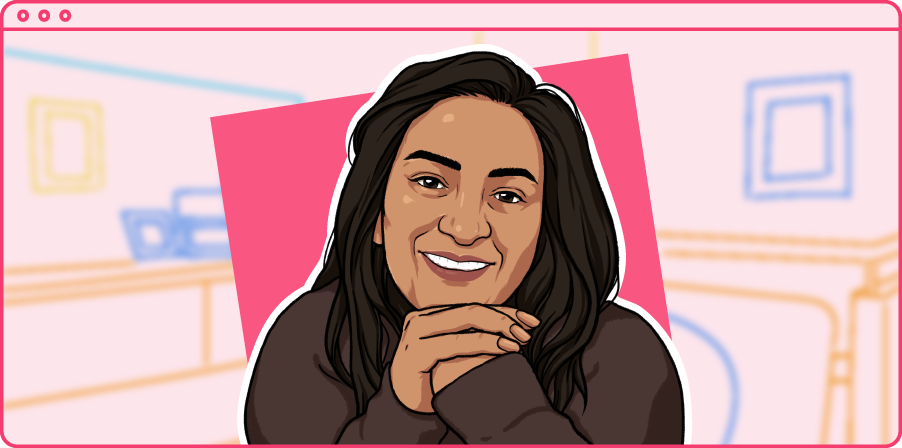
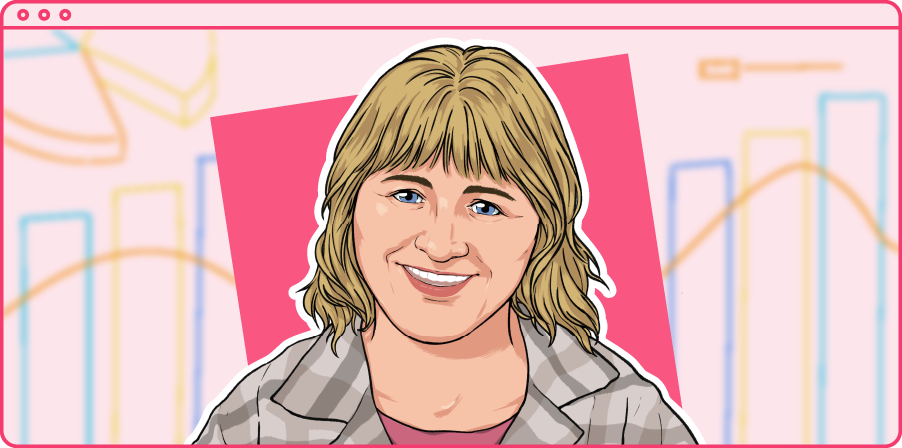
This instalment in our Women’s Entrepreneur Series is an interview with Sonya Amin, co-founder of AXS Studios, a specialized agency that creates illustrations, animations, and interactive experiences to explain biomedical science. AXS works with pharmaceutical companies, medical device companies, educational institutions, and TV shows to convey science accurately and memorably.
In her conversation with Workomics, Sonya talks about why she started AXS, and how her business has evolved over the last twenty years
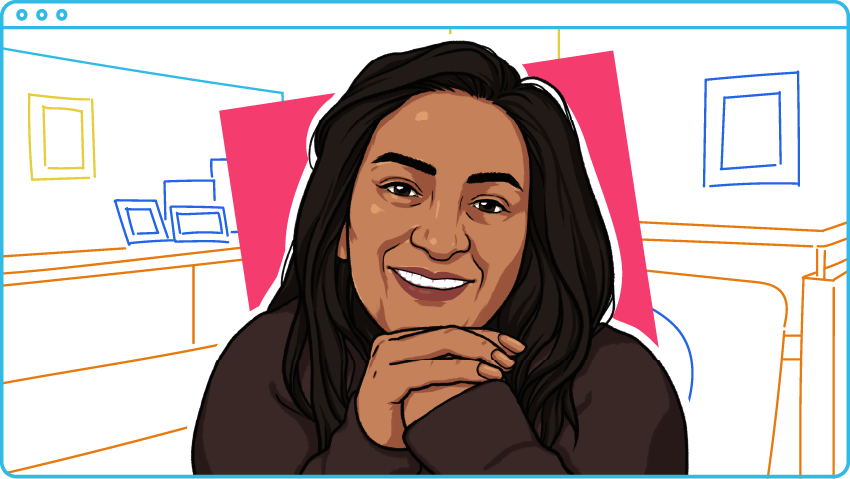
WORKOMICS: We know you got into this line of work with a graduate degree in biomedical communications (BMC) at the University of Toronto, where you built all kinds of specialist capabilities in communicating science and medicine. But many—if not most—people who come out of that program go get jobs working for a firm. You took a different path, so we’re curious to hear the story of how that came about.
Sonya Amin: Life choices, Susan, life choices [laughs]. I graduated from U of T in 2003 and at the time, the job prospects weren’t great in Toronto. While at BMC, I met two of my classmates, Jason and Eddy, who are my business partners now. For the animation part of the program, we would carpool the half-hour from Toronto to Sheridan College in Oakville. We spent a lot of hours in Jason’s grandmother’s 1990 Ford Taurus, just thinking about the future. Specifically, what the hell are we going to do to make a living if nobody’s really hiring for visualization work?
We got to know one another really well during that carpooling. We saw each other’s talents and that we were pretty simpatico in a lot of ways — we complemented each other. After we graduated, we stayed in contact and started doing a little bit of freelance together. Then the science advisor on a TV show called ReGenesis reached out to the BMC faculty at U of T looking for help with scientifically realistic animation.
That was the project that got AXS started — it turned into a three-year gig. We said, “Yes, let’s start a company, how hard could it be?” [laughs.] We applied for and were accepted into the business incubator space at MaRS* and that was our first office.
WKO: When you started out, did you have a longer-term plan or were you just going to ride the three-year wave?
SA: We were going to ride this wave. We hoped it would be the start of a successful company, of course, but there wasn’t a 20-year plan or even a 5-year plan. We built AXS from scratch. We had to figure out who was going to do what and learn the basics of how to run a business, while running a business. It was a big help to be in the MaRS incubator — management of the space was taken care of and we could talk to other entrepreneurs who were in the same boat, trying to figure things out. We were introduced to our accountant that way, and he’s still our business advisor now.
WKO: How long was it just a three-person operation?
SA: We had a contractor almost right away because there was a lot to do, and we hired our first employee in 2007. I want to say it was two or three years on our own, working many, many late nights ourselves, with times of feast and famine. We had to get to that point where we felt AXS could sustainably employ someone else.
In the beginning, we had other jobs too. Eddy was teaching at BMC and working at a commercial animation company and Jason was doing academic research at U of T. But there was a moment where it all came together and AXS became the full-time focus for all of us. It wasn’t just a gig; it was a career and it was a company.
WKO: How would you describe your evolution over the last 15 years?
SA: We’re definitely a cautious bunch, Jason, Eddy and me. Right now, we’re 21 people including the three of us. We don’t subscribe to the “grow or die” mindset. We want to grow a team that has a lot of trust and talent. We want to focus on the quality of the work. We want to be able to deliver the things that we say we’re going to deliver. So for us, slow and steady growth works. I find when we grow too fast, quality of relationships and of the work can suffer, and we don’t like it.
Our vision statement is to bring clarity, credibility, and delight to science visualization. We drafted those words as a team very deliberately. Clarity, credibility, delight, are definitely three things we value, and they all take time. Slow growth is maybe not what every business strives for, but I feel like that’s our comfort level.
WKO: Quality doesn’t scale, not with any speed.
SA: Yes, exactly. It’s difficult. And quality is our business’s core reason of being, and what our clients are expecting of us.
WKO: The thing your clients expect of you and the thing you expect of yourself, if we had to wager a guess.
SA: Yes, absolutely. If it was just ‘slap it together and ship it off,’ I don’t think that people who are as thoughtful and creative would be working at AXS. That’s really who we want to be: thoughtful, creative people.
WKO: Do you find that there are clients who don’t actually see the differential value between work that is “fine” and work that is excellent? And how do you navigate that within the culture of your organization and what people want their work to be?
SA: We definitely find that. It’s a tough challenge, as we often discover it during a first project with a client. That’s a tricky path to navigate for our project managers at AXS. You have to be able to dig out what the client cares about and present it to our team. As long as we’re able to articulate what a client wants, our team can work with it. It’s when it’s unsaid or unclear that it can be problematic. We had a client once repeatedly ask for a piece to be changed to add “more beauty,” and it took a solid week of reworking options and head-scratching to help them articulate that they meant, “make it blue.”
WKO: There is an art to unpacking what people truly care about, because often they don’t know themselves. They’re not sitting there being coy.
SA: That’s fair. Sometimes you need something to react to in order to know what you want.
Another challenge for us is when there is a perceived budget/quality mismatch. We care about quality, but there’s still a project budget that varies client to client. If we can articulate what the client does care about, then we know where to focus our efforts. Otherwise to our staff it looks like, “You want me to do the usual magic in that amount of time?” I think it’s very similar to one of the Workomics’ newsletters which was putting a time on tasks and communicating what “good enough” looks like in each case. Without that, our staff just went to, “I’m going to do all the same things and just somehow work faster.”
WKO: Amongst our interviewees for this series, we think you are the only business owner who is outnumbered by men as a partner in your business. We’re curious if you could talk a little bit more about that dynamic in your relationship as it’s unfolded over twenty years.
SA: Yes, definitely. It’s been a journey. In the beginning, I was not only the female partner, but I was also taking care of what some might consider more traditionally “female roles” in the company. I was doing finance, admin, project management, HR, space management — someone has to plan the renos and organize the office kitchen.
We were chatting with a business advisor to figure out which one of the three of us would focus on sales. At this time, I was the only full-time person at AXS, but the advisor said, “Well, obviously Jason should be doing the sales.” I asked, “Obviously Jason should?” And he said, and I quote, “Well, you know, you’re more the den mother.” I didn’t reply, but you could see the death rays coming out of my face, and he said, “No, no. Don’t take it like that. There’s a quiet dignity to what you do.” It was a low moment.
Operational things are not always given the respect they are due. At AXS we make a point of letting each other know all our efforts are important and appreciated. But back when we started, there was a little bit of insecurity to navigate — maybe because of comments like that.
There were also differences in our roles in our households, especially when all our kids were little. I do find that moms do that last shift of work: organizing medical appointments, playdates, taking care of kids who are sick. Not every mom, but perhaps it’s a stronger default.

We’ve been through a lot together over 20 years. I’d say every year is a discovery. It’s not a linear evolution of a relationship. The business changes and then we change and adapt. Then it changes again and then we figure it out again.
Compared to when we started, we use our words a lot better. We’re able to be more direct but still kind to one another. We’re not in a hurry to assume what the other person means, but actually ask, “Can you help me understand?” We have more emotional intelligence now compared to when we started. It makes it a lot easier to deal with the big stuff like, oh I don’t know, global pandemics.
WKO: That’s a good segue into asking about how COVID shifted your business, and perhaps also how it shifted your outlook on work and how you spend your days.
SA: The biggest difference is we were 100 percent a butt-in-seat kind of company before the pandemic. You had to have a really good reason why you could even have one day a week working from home. There was not a lot of flexibility for work-from-home — and then it turned on a dime. We don’t have an office anymore! Although we do lease co-working space for meetings and a chance to get out of your four walls for a change.
How well we are able to work remotely made us appreciate the trust we had built in-person. We just implicitly trust one another to get stuff done. Now we’re fully remote with employees across three time zones. There’s no going back. Our next challenge is how we can build that same level of mutual trust with fully remote employees that have joined us since the pandemic started.
Our team still does crave connecting in-person. That’s a real human being and not just pixels on a video call. So we’re doing social and team-building events in-person, with the opportunity to fly our farthest flung people in. It’s a start.
WKO: We’re curious to hear your perspective on how it’s different to run a business, as distinct from working as an employee.
SA: I think at the beginning what made it possible is how each of us reacted when we didn’t know how to do something. We tended towards, “I’ve just got to figure it out.” The figure-it-out attitude was our secret sauce. You don’t know what you’re doing, and that’s OK! For me, putting in that time to figure it out was synonymous with caring. And that’s what we did with everything. Have to set up a server? Just figure it out! Have to prepare T4s†? just figure it out. And if you make a mistake, own that mistake, learn from it, and don’t do it again.
I know “figure it out” isn’t everyone’s default. Some people want process and training. I struggle with that because it’ll never be exactly the way it’s written on paper. Ever. Decision trees are helpful, but life is never going to follow it exactly. I try to go with a high level of, “Do some good”. Think about the risks of doing it right or wrong and then act accordingly. You don’t really need a huge decision tree; there’s no substitute for judgement.
*MaRS is a Toronto-based NGO that supports start-ups and helps them scale.
†T4s are the forms Canadian firms use to report annual employee earnings to the federal tax authorities.
Our other ideas worth exploring
Knowing when to start, and stop
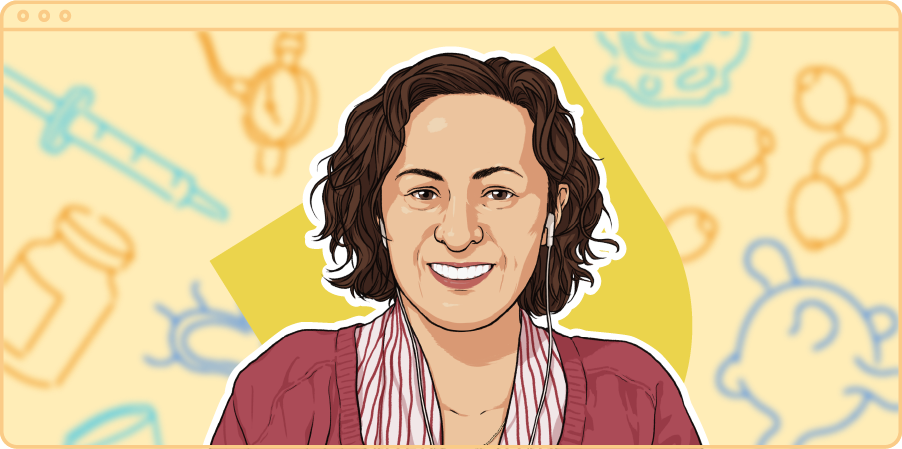
Ella Korets-Smith talks about starting two different biotechs, the experience of winding one of them down, and how she prioritizes relationship-building.
Throwing out the instruction book
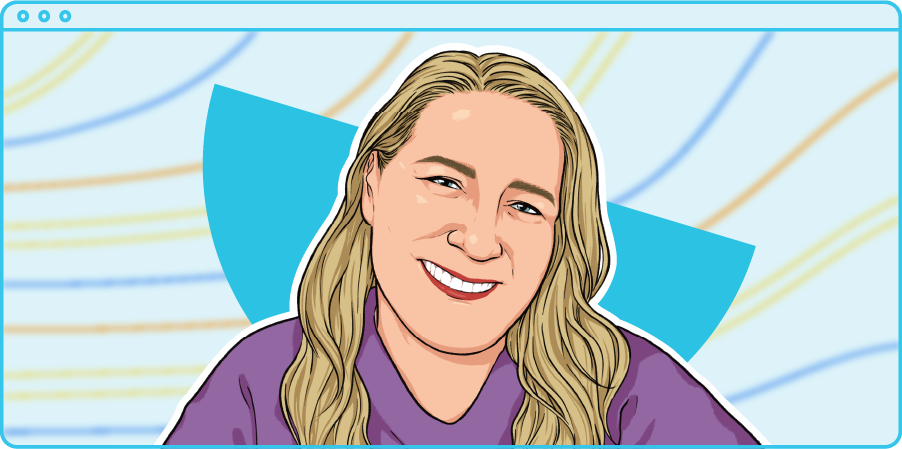
Melissa Williams, founder of Simply Patient, discusses why patient-centricity can be challenging in pharmaceutical companies, and how she stays laser-focused on bringing patient voices earlier in drug development.
"I want to hang my hat on me"
Krista Lee Hynes, co-founder and managing partner at Ignite Financial, talks about her journey from theatre to financial planning, and why she has always bet on herself.